Showing posts with label ProgRock. Show all posts

Monday, November 25, 2024

The "Universal TCXO" - better stability for the Kenwood TS-590, TS-570 (and other radios) using the QRP Labs ProgRock 2

Figure 1:
The TS-590G into which the ProgRock was installed.
A useful accessory for many amateur transceivers is a TCXO - a device, often offered as an option, that improves the absolute frequency stability and accuracy of the radio.  When in current production, the TCXO is available from the manufacturer - and possibly from third parties - but long after the radio has been made, a TCXO may be difficult to find.

One option for addressing this issue is the use of the QRP Labs ProgRock 2 - LINK.  This unit is relatively inexpensive (US$18 at the time of writing) and has a stability of 0.25ppm - which is likely better than the original TCXO offered by the manufacturer - and likely less expensive as well.

This page describes not only the installation of the ProgRock 2 in a Kenwood TS-590, but also in the TS-570:  These two radios use very different frequencies, but the ProgRock 2 is easily programmed to whatever is needed!

Any weird frequency

While it would be convenient if radios had a nice, easy frequency like 10 MHz as their main oscillator, that is rarely the case - and this was true for a friend's TS-590G which wanted 15.6 MHz.  This radio, which he purchased second-hand, did not come with a TCXO and based on his experience during June Field Day and winter Field Day (in January) it drifted excessively - more than a few 10s of Hz on 10 meters - enough that he would occasionally get complaints about him being "off frequency" - even if it was he that was calling CQ!

Although an aftermarket unit was available, he was intrigued by the idea of using the ProgRock 2 as this same device could be programmed for any frequency between about 3.5 kHz and somewhere near 300 MHz with a resolution of 1 Hz.  Additionally, the ProgRock 2 allows the use of a 1 PPS (1 pulse-per-second) output from a GPS module to "discipline" the oscillator with even greater stability - but more on this later.

Prepping the ProgRock 2

Using the ProgRock 2 is pretty easy:  It has a micro-USB connector onboard and when plugged into a computer, it can appear as a serial port - refer to the manual for the appropriate driver.  Using a serial terminal program - like PUTTY - one simply enters the frequency, to the nearest 1 Hz, hit the "S" key to save it to memory and you are pretty much done.  The ProgRock will allow the output of more than one frequency if needed (the manual has more detail) but we will be using output #1, which is also the one into which we'd program the needed frequency, setting the others to zero (e.g. "off").

Figure 2:
ProgRock 2 with the 3.9 and 10k resistors mounted to allow
the external application of a 1pps signal from a GPS module
to stabilize the frequency further.  The bottom side of the
ProgRock 2 is shown.
Click on the image for a larger version.

Having said that, there's a bit more to it in that it needs power, ground, and the signal output needs to get into the radio - but more on that in a moment.  

As my friend wished to experiment with using a 1 PPS source to nail it down to frequency, a 3.9k series resistor was added to the "1pps" pin along with a 10k resistor to ground to keep the pin from "floating" around in voltage when nothing was connected to it.  Figure 2 shows these resistors mounted on the "bottom" side of the board:  The upper resistor is the 3.9k connected to the 1pps pad with the lower, 10k resistor connected to a ground pad.  The junction of the two (with the yellow piece of insulating tubing) is where the 1pps input would be connected.

The use of the 3.9k resistor is described in the ProgRock 2's documentation which notes that the onboard microcontroller operates from 3.3 volts - but placing this resistor in series (the value of which isn't particularly critical) limits the current into the logic pin, allowing it to be safely driven by a 5 volt - or even 12 volt - 1pps pulse. 

Figure 3:
The Progrock 2 mounted to the original TS-590 TCXO board
using short, insulated jumper wires.  The top side of the
ProgRock 2 is shown.
Click on the image for a larger version.
As noted in the ProgRock 2's documentation, as long as the 1pps pin is held low, it's ignored and the unit will operate based on the frequency set by its onboard oscillator, but when it sees the 1pps pulses, it measures the time between their rising edges to determine how far off the internal clock is from ideal, making slow, incremental changes.  If the 1pps signal were to later disappear, it would simply "hold" that frequency until the ProgRock 2 was power-cycled at which point it would revert to the internal clock unless/until it was again presented with a 1pps signal.

There's a place for it!

While the "stock" TS-590 did not come with a TCXO, there was a small "daughter" board adjacent to the portion of the circuit board with the stock oscillator on which the user is expected to solder a TCXO in the form of a "crystal can" oscillator module - or, in the case of some after-market units - replace that board entirely.  As the ProgRock 2 is roughly the size of a postage stamp (it will fit within an HC-6 crystal can!) it could be wedged on this same board - which is convenient as this board also carries 5 volt power for the original TCXO, so a bit of pretty easy "micro" surgery was undertaken.
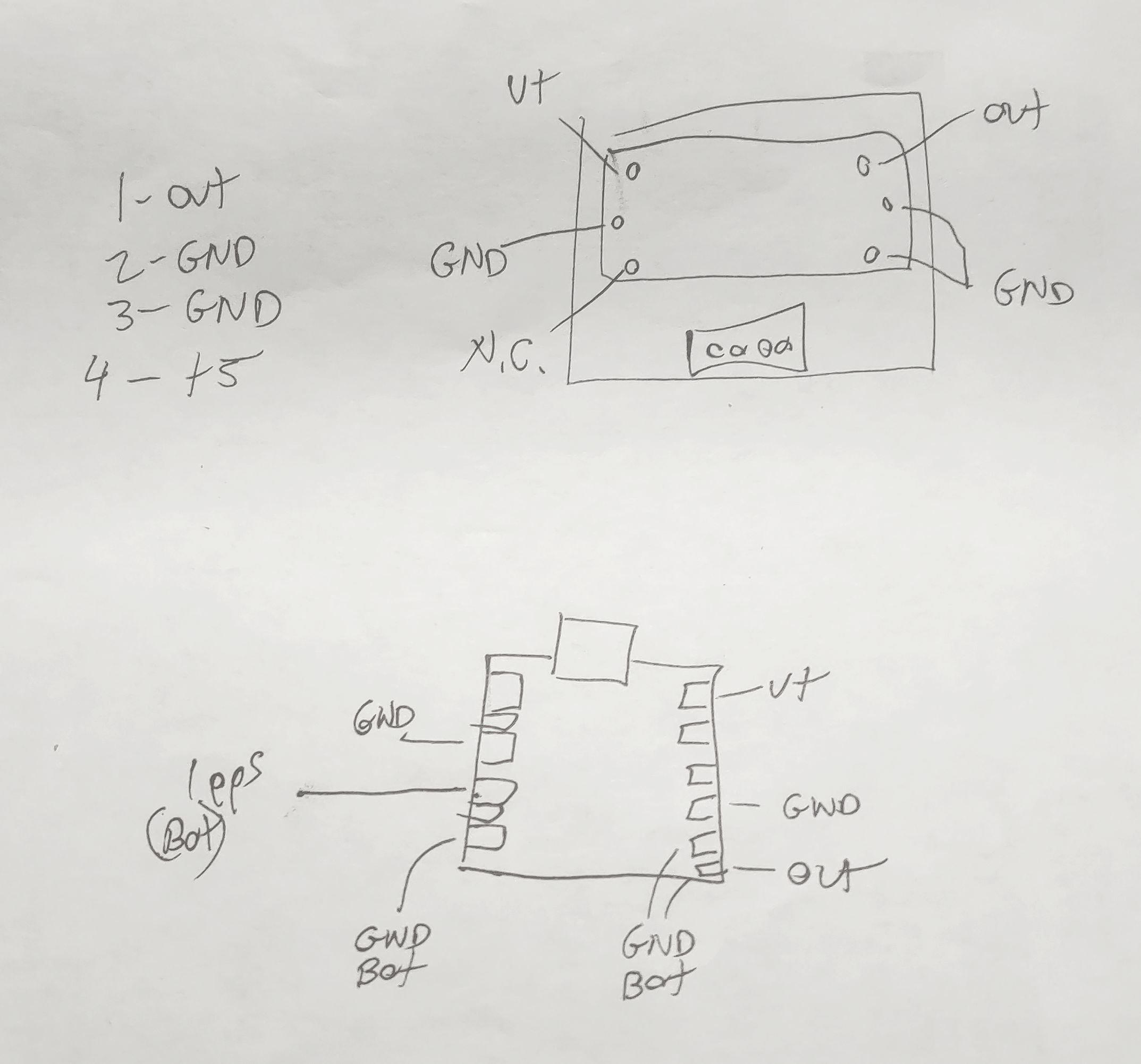
Figure 4:
A hand-drawn diagram showing the connections
on the top side of the TS-590's TCXO board and
the ProgRock 2 board.
Click on the image for a larger version.

Figure 3 shows how the ProgRock 2 board was mounted on the original TCXO board.  Fortunately, all of the needed connections are there:  +5 volts to run the original TCXO, ground, and the signal output.  Figure 4 shows a hand-drawn diagram showing the original TCXO board (top) with its pin locations while a representation of the ProgRock board (with the USB connector oriented on top) is in the lower drawing along with its connections.

Using small gauge, insulated wire liberated from a scrap of CAT5 Ethernet cable, short-as-possible jumpers were run between the TCXO board and the ProgRock.  In Figure 3, the "ground" connections were made using green wire - one of them utilizing the body of the USB connector - while the output signal used blue and the power used orange:  In the upper-right corner of the ProgRock 2 board - just above the USB connector - you can just see the yellow insulating tubing of the 1pps connection.

There is JUST enough room - if one scrunches the edge of the ProgRock 2 board against the TCXO board's white connector (and by routing wires such that they are not between the ProgRock 2 board and the connector) so that it will fit in the original location within the TS-590 as can be seen in Figure 5, below.

Comment:

It was noted - during testing of the TS-590 - that  the combination of 10 meters at 100 watts while using the built-in tuner - seemed to "glitch" the ProgRock for reasons unknown, although it's suspected that magnetic fields from the PA/Tuner board are finding their way through the aluminum chassis from the opposite side.  Simply tipping the ProgRock 2 board from being flat against the original TCXO board to more of an angle and adding another ground wire jumper to the TCXO board seemed to fix this.

One important consideration is that you MUST be sure that there's a blocking capacitor somewhere between the output of the ProgRock 2 and the input of the circuit that it's driving.  As it turns out, the stock TS-590 TCXO board has such a blocking capacitor - but if your application does not, or you are not sure if it does, simply use a 0.001 to 0.1uF capacitor in series with the output - and this capacitor may also serve in lieu of a jumper wire in connecting it to the radio.

Finally, don't forget to disable the original oscillator of the radio into which you are installing the ProgRock 2.  In the case of the TS-590, there are two jumpers that must be removed - one to cut power to the original oscillator and the other to disconnect its output - these black jumpers are just visible to the right of the orange connector on the jumper cable to the TCXO board on Figure 5.  In some radios the TXCO replaces the original oscillator entirely so there's no need to "disable" it.

Figure 5:
The TCXO + Progrock 2 boards, installed in the TS-590.
There is enough wire length to connect the USB to program
the ProgRock in-situ if the mounting screw is removed.
Click on the image for a larger version.

Checking the calibration

You might notice that the TS-590's TCXO board is connected with a short, 4-wire jumper (the red, black and green wires in Figure 5) and this is long enough to allow connection of the ProgRock 2 board to a USB cable and a computer to allow the frequency to be adjusted "live", while the radio is in operation - this requires removing the single mounting screw to permit the board to "hang loose".

Simply setting the ProgRock 2 to 15.6 MHz exactly in the configuration menu resulted in the TS-590 being within 2 Hz of the correct frequency when checked against the 10 MHz WWV/H signal - this difference likely because the ProgRock 2's onboard 25 MHz oscillator was very slightly off, but well within the 0.25ppm tolerance.

But what if you wanted it to be closer?  Keep in mind that the frequency tolerance of the ProgRock 2's own TCXO is 0.25ppm which amounts to as much as 2.5 Hz at 10 MHz (or 7.5 Hz at 30 MHz) so absolute accuracy over a wide temperature range is unrealistic - but "dialing it in" at the typical room temperature (or that of the radio's interior after it has been on for a while) is quite reasonable - although there's a caveat to this if you plan to use the 1pps input as we'll soon discuss.

Dialing it in

If you have an ultra-precise frequency reference such as a GPS-disciplined oscillator or a Rubidium reference, by all means use it - but if you don't, you can use an off-air frequency reference like WWV, WWVH, CHU, BPM, or whatever else is near you that is KNOWN to be very precise - but the higher the frequency, the better.

Using 15 MHz WWV as an example, tune the radio USING THE KEYPAD so that it is exactly on frequency:  Note that the TS-590 can tune smaller than the 10 Hz steps shown on the display, so turning the dial doesn't guarantee that you are on the "zero Hz" frequency step.  Without bumping the main tuning knob and knocking it off by less than a 10 Hz step listen for the WWV transmission to hear the portion when they are transmitting the 500 or 600 Hz tone (this step won't work if they are not transmitting this tone) and switch between USB and LSB:  If you hear any difference in tone, you may wish to tweak the ProgRock's frequency up or down as appropriate.  If the tone on USB is slightly lower than that on LSB, the ProgRock's frequency needs to be set slightly lower.

An alternative method to setting the frequency is to use a spectrum analysis program - "Spectran" by I2PHD (LINK) is probably the easiest to use.  In this case, one would tune Spectran for a 1 kHz tone and configure it to pick up the audio via the computer's microphone or a web cam - or using a direct audio connection such as a rig interface or audio cable from the radio.  If you are using WWV/H for this, it's suggested that you first listen using AM and verify that your sound card's sample rate is accurate, with Spectran showing precisely 500 or 600 Hz during the periods when WWV/H is transmitting those tones.  If you find that it's not showing exactly 500 or 600 Hz (to within a Hz or so) you may wish to try a different sound card/computer combination or just do a bit of math to compensate for the slight difference in the audio card's sample rate.

Using USB on the TS-590, tune exactly 1 kHz below WWV/H (e.g. 14.999 kHz) using the keypad and measure the frequency of the carrier:  If the tone frequency measures slightly high when using USB, the ProgRock's 15.6 MHz frequency can be increased slightly - but remember that it may be done only in 1 Hz steps.  Remember that 1 Hz at 15.6 MHz will cause a frequency shift of about 0.6 Hz at 10 MHz and almost 2 Hz at 30 MHz as the effect will be proportional to the radio of the reference frequency (15.6 MHz in this case) and the frequency to which the receiver is tuned.

Note:  If you have a known-accurate reference oscillator of your own (such as a GPS Disciplined oscillator, Rubidium oscillator or similar) by all means, use it!

Comment about tuning step size.

Many modern transceivers tune in 10 Hz steps or finer - but note that these steps are often not exactly what they may seem.  For example, some radios' 10 Hz steps aren't exactly 10 Hz each - some being a bit more, some being a bit less - but that they will average 10 Hz steps.  The same goes for the smaller step sizes as well.

Keep this in mind when you are attempting to set/measure a given radio exactly to frequency as this slight difference in step size may result in some frequencies being slightly different from what is expected and this difference may vary by seemingly random amounts.

Using the (optional) 1pps input on the ProgRock 2

As noted earlier, the ProgRock 2 can take a 1pps input from a GPS receiver module, using this to make gradual corrections of the frequency.  Doing this if the GPS signal is reliable will result in the frequency being very stable over a wide temperature range, but there are two caveats to this:

  • The ProgRock 2 doesn't (yet?) have in its firmware a means by which one can input an offset of its 25 MHz TCXO frequency.  As the onboard 25 MHz TCXO is not likely to be exactly correct, this means that if you set set the frequency at room temperature - and the oscillator is slightly off - when you apply a 1pps input the frequency will then be shifted assuming a 25 MHz clock frequency.  The reason for this is that the 1pps will set the frequency as if the onboard 25 MHz TCXO were 25 MHz, exactly - but since it probably isn't (remember - it's rated to be within 0.25ppm) a frequency shift will result.
    • In other words, if you want your radio to be precisely on frequency with a 1pps input, you will have to "dial it in" with 1pps applied and expect it to be slightly off when no 1pps signal is present.
    • If you ever do apply a 1pps signal - even briefly - the Progrock 2 will "remember" that offset even when the 1pps is removed until the unit is power-cycled.  If the 1pps is removed, the oscillator will now be free to drift with temperature. 
  • The frequency step corrections as a result of the 1pps input are not infinitesimally small.  What this means is that with 1pps applied, every second the frequency will shift slightly, typically hovering above and below the target - but the magnitude of these corrections may be set in the configuration of the ProgRock 2.
    • For most modes on HF - including FT8, FT4, PSK31, CW, Sideband or even many digital modes - these small "sub-Hz" shifts would likely be inconsequential. 
    • If you are using a digital mode where fractional-Hertz frequency shifts are important, you may want to carefully consider using 1pps at all, weighing the pros and cons of having seemingly random small frequency shifts.  Modes where this may be important would be WSPR, FST4W (particularly the modes longer than 2 minutes), coherent CW, during an FMT (Frequency Measurement Test) or any other instance where small frequency steps may be disruptive.
    • If you are in a situation where the continual frequency correction is an issue but you want the frequency to be closer than what the TCXO onboard the ProgRock will allow you might consider manually applying the 1pps signal intermittently to occasionally recalibrate the frequency.  This would allow the frequency to drift slightly with temperature between calibration intervals.
    • While one may configure the adjustment size in the ProgRock 2 and likely minimize the size of the frequency adjustment steps, remember that it must be capable of correcting for the normal and expected frequency changes related to temperature.  This need sets a minimum correction size that will be practical and the varying environments with differing temperature and its stability will affect this.
    • If you are using a 1pps input on a radio that operates in the VHF/UHF and/or microwave frequencies, these small frequency shifts will be proportionally larger and may even be noticeable on SSB and/or as slight "clicks"in received audio - possibly making the radio unusable for digital modes altogether.  It may be possible to configure the ProgRock 2 to mitigate this somewhat by reducing the magnitude of the corrections, but they will always be there.

* * *

A ProgRock 2 in the Kenwood TS-570

The (older) Kenwood TS-570 (all variants) can also be retrofitted with a ProgRock 2 in lieu of the Kenwood "SO-2" TCXO - and it's also pretty easy.  Using the same steps as above, program the ProgRock 2's "Clock 0" for 20000000 Hz (20 MHz exactly).  I modified my own TS-570 for the same reason that my friend modified his TS-590:  The original oscillator would audibly drift in frequency with temperature and it was over 100 Hz high on 10 meters  (approx. 25 Hz on 40 meters) once it warmed up, causing the occasional complaint that I was off-frequency.  I do not use this radio for digital modes like FT-8, but if I had, I'm sure that I would have made this modification some time ago!

Figure 6:
The ProgRock 2 installed in place of the original Kenwood
SO-2 TCXO in the TS-570.  The wires through the
board were bent and soldered to the V+ and three
ground pins.  The output of the ProgRock 2 is
connected to the "out" pin on the board via a 47 ohm
and 1000pF capacitor in series.
Click on the image for a larger version.
Via online search, you can find the instructions for installing the SO-2 TCXO module and these show how the PLL board (the one in the bottom of the radio) may be removed:  Be careful with the flat ribbon cables!

Rather than solder in the TCXO, cut five short pieces of tinned wire (20-24AWG, 0.6-0.8mm dia) to be about 3/4" (20mm) long and solder them in the five holes into which the original TCXO was soldered and re-install the board.

On the board itself you'll notice that two of the holes are marked - one for power and one for the "out" pin of the TCXO into which we will feed our 20 MHz clock from the ProgRock 2:  The other three pins are ground.  First, the ProgRock 2 is "dry fit":  It is placed on the circuit board (with a piece of foam or cardboard underneath to space it slightly away - perhaps 1/8" to 3/16" or 3-5mm) and the wires that we soldered bent around to the contact pads and trimmed, taking care that they not touch the pads on the back side of the board or anywhere else that they shouldn't.

As can be seen in Figure 6, the "V+" pin was wrapped around and soldered to the "V+ pin (which carries 5 volts) on the ProgRock 2 (the one in the lower-right corner of the ProgRock board in Figure 6) while two of the the three wires for the ground connect to top-side "GND" pads on the ProgRock while the third is soldered to the top of the USB connector.  As the ProgRock 2 is very light, these wires are more than adequate to hold it into place - just be sure to keep the board height low enough to avoid interfering with the shield when it is replaced.

The top-right corner pad on the ProgRock 2 in Figure 6 is the "CLK 0" that we programmed - but like the TS-590, it must be capacitively coupled to the clock input on the TS-570 and this is done with a series capacitor:  I used a 1000pF capacitor for this, but anything between 470pF and 0.01uF would be fine.  On the schematic I noted that there is a 10pF capacitor to ground in the TS-570 on the "out" pin so I also included a 47 ohm resistor in series with the capacitor just in case the output of the synthesizer would be "unhappy" with capacitive loading - and also to reduce the amount of RF drive into the '570's clock input.  This resistor may not have been necessary, but hey, it's just a resistor so why not play it safe?  The final steps are to cut the two resistors, R503 and R504, seen to the right of the ProgRock 2 board:  This necessary step disconnects the power and the output of the original oscillator circuit.

Upon reassembling the TS-570, I tuned in WWV on 5 MHz and switched between LSB and USB (with the RIT set to zero) and heard no discernible change in pitch during a part of the transmission with the tone indicating that the radio was "dead on" frequency.  As the ProgRock 2 is rated for 0.25ppm stability, it should stay within 5-8 Hz on 10 meters, worst-case - about 1/20th as much drift as with the original oscillator!

While I could have done so, I chose not to add the resistors to permit the external application of a GPS-based "1pps" input to "lock" the ProgRock 2, as was described above for the TS-590.

From start to finish, it took me about an hour to program and install the ProgRock 2 in my TS-570 - but your mileage may vary.

* * *

Using the ProgRock2 in other radios

As the ProgRock2 can be programmed for about any frequency you like, it can be used in radios other than the Kenwood TS-590 or TX-570.   The ProgRock 2 draws a modest amount of current (40-60mA) so its addition will likely not be consequential in power consumption on "desktop" and "mobile" radios - but it may be significant on a QRP or portable radio.  It's likely that most radios do NOT have a handy board onto which the ProgRock 2 may be easily mounted like the TS-590, but the unit is small enough that it will likely fit in/near the location intended for the oscillator/TCXO.

Be sure to use as short as leads as practical and it will likely be necessary to use some sort of adhesive (foam pad or glue) or some sort of "zip tie" to hold the ProgRock 2 board into place.  If possible, be sure to install it such that the ProgRock 2 may be moved so that its USB port may be connected to a  computer to allow final tweaking of frequency once it is installed - at least before it is secured into place:  Once the frequency has been "dialed in" it's unlikely that you'll need to readjust it any time soon.

The ProgRock 2 is also rather flexible in its power supply, but even though it is rated to 12.0 volts, I would NOT recommend allowing more than 10 volts ever be applied to it - and the input voltage can be as low as around 4 volts meaning that it's likely that if the radio itself has an already-existing supply rail (5 volts like the TS-590 - many radios have an 8, 9 or 10 volt supply as well) that will work nicely or one could use an appropriately-chosen series resistor (likely in the 47-82 ohm range for a 12 volt supply - but please do your own measurements) to drop its supply by a few volts.

As noted above, you must be sure to keep the DC on the output terminal of the ProgRock from being shorted to ground (via a transformer or inductor to ground) or to another voltage source (such as a bias network of an amplifier/buffer) as it has no blocking capacitor of its own.  In the TS-590 the original TCXO board had its own blocking capacitor - but if your intended circuit doesn't have such - or if you don't know if it has one - simply add a 0.001 to 0.1uf (value not critical) series blocking capacitor of your own.

Most "recent" radios (e.g. those made since the early-mid 90s) have a single frequency reference for their synthesizer - but ones prior to this (and a few after) may have more than one master oscillator that determines the precise frequency.  It's worth noting that the ProgRock 2 can output more than one frequency at a time (three if you are not using the 1pps input - just two if you are) and it may be possible to program one of the ProgRock's other outputs to another useful frequency.  One possibility is for very old analog radios that sport a 100 kHz crystal calibrator or similar:  The ProgRock 2 would be excellent for this purpose.

In some cases, these "other" frequencies may include the radio's BFO (Beat Frequency Oscillator) or HFO (Heterodyne Frequency Oscillator) in which case you may need to be more creative - but it's worth noting that the ProgRock has up three "digital" inputs that may optionally be used allowing up to eight separate frequency combinations to be produced - possibly allowing one to replace impossible-to-find crystals in vintage radios - but this is a possible topic of another article.

* * * * *

This post stolen from ka7oei.blogspot.com

[END]


Wednesday, March 24, 2021

Using the QRP Labs "SoftRock" as a possible crystal replacement in "rock bound" VHF and UHF radios

As technology moves on, it is getting more difficult to find custom-made quartz crystals.

Why would one need a quartz crystal in these days of frequency synthesizers?  They can't really be beat for simplicity and stability in many applications. While it may be preferable in many cases to just use a cast-off synthesized radio, there are still some compelling reasons to use older "rock bound" radios used for linking and repeater where frequency agility is not important.

Many of these older radios have multi-section, narrow-band helical resonator front ends which provide protection above and beyond many modern radios and repeaters for rejection of off-frequency signals - often very important for linking and repeater sites:  Many users have replaced their old "rock-bound" repeaters with "store bought" Icom or Yaesu repeaters at busy sites only to discover that these new radios - with their intrinsically broad front ends - were being clobbered by signals that managed to get around their duplexers!

For an explanation as to why that happens, read THIS article about duplexers:  When "Band-Pass/Band-Reject duplexers really aren't band-pass"

Given that one might be using a rock-bound radio for a specific application, the recent demise of International Crystal Manufacturing (ICM) in the U.S. makes these crystals harder to obtain although there continue to exist other companies, such as "Quartslab" in the U.K., that can supply custom crystals.

What about retrofitting such a radio with a synthesizer?

The "ProgRock"

The "ProgRock" (short for Programmable "Rock" or crystal) is a device sold by QRP Labs in the U.K. (link) consisting of two parts:

  • An Si5351A-based frequency synthesizer
  • An Atmel-based microcontroller board that sets the frequency of the synthesizer.

The Si5351 chip, made by Silicon Labs, contains several on-board oscillators and dividers making it capable of producing frequencies ranging from high audio to somewhere "north" of 200 MHz with "parts per billion" resolution over most of that range.  Capable of up to three independent frequency outputs, only two outputs are typically used owing to hardware limitation related to the number of internal synthesizer blocks and the fact that there is a bit of crosstalk between each of the three channels.

What this means is that while in theory one could use a single ProgRock for both receive and transmit simultaneously - as in a repeater - it may not be a good idea as low-level spurious signals from the "other" channel may cause low-level spurious responses:  While this may not be an issue for receive, it would be a bad thing for a transmitter - particularly when used for full-duplex repeater service where extremely low-level spurious signals may get into the receiver or when the transmitter is at a shared site and very low spurious products could get into other people's receivers!

On the other hand, if the radio in question is half-duplex (e.g. not receiving and transmitting at the same time) one of the features of ProgRock, the ability to select multiple channel "banks", can be used to enable one channel with the receive frequency and then the other channel for the transmit frequency as needed.  By having just one synthesizer active, the production of low-level spurious signal is minimized.

Note about the original ProgRock and newer ProgRock2:

Since this page was originally posted, QRP-Labs has discontinued the original "ProgRock" and replaced it with the "ProgRock2".

This new device has all of the features of the original ProgRock - plus it comes with a 0.25ppm TCXO, providing better stability than (pretty much) any crystal oscillator used in "rockbound" radios - and it costs the same, too!  Additionally, it is much smaller, programmable via USB (using a serial port emulator) and it comes pre-assembled.

Important:   If you use the ProgRock2, avoid powering it from more than 7-8 volts as the thermal design related to the onboard 3.3 volt regulator  - which cannot tolerate more than 12.0 volts - is somewhat marginal at higher voltages - particularly at elevated temperatures.   It is strongly recommended that it be powered from 5 volts (e.g. via a 7805 regulator).  

Alternatively, knowing that the nominal current consumption of the ProgRock will be between 30 and 60mA - assuming worst-case, a 120-150 ohms 1/2 watt resistor will result in a voltage drop sufficient for 12-15 volt operation.  The resistance is not critical - it just needs to result in 4-8 volts at the ProgRock2 under its expected load and frequency configuration.

For more information visit the QRP-Labs ProgRock2 web page - LINK.

While the original ProgRock is described as being used, it applies to the newer ProgRock2 as well.


Case study:  The GE Mastr II

The GE Mastr II is a crystal-controlled product line made from the mid-late 1970s into the early 1980s and aside from a few minor issues (e.g. the tendency for the receiver 's helical resonator castings to grow "hair" [e.g. metal dendrites] and make the receiver deaf - a problem easily remedied by the application of spray-on clear coat after cleaning and degreasing) it is a solid performer with very strong receive filtering and the ability to get many of the parts on the new and surplus market.  What we need, then, is to effectively simulate a crystal oscillator module (called by GE an "ICOM" - no relation to any other radio company!) to produce the desired frequency.

One potential advantage in this application is that the transmitter itself is modulated using phase modulation.  What this means is that the crystal itself (or any other type of frequency source) is unmodulated, with the audio added in the later stages using variable reactance techniques and this means that we do not need to figure out how to modulate our synthesizer directly.

Having an unmodulated signal source as our transmit frequency determining component is actually quite convenient as it provides the opportunity to "nail down" the transmit frequency with as much precision as you wish, allowing multiple transmitters to be "synchronized" to precisely the same frequency.  In contrast, transmitters with modulated crystals or PLLs have a tendency to "wander" a bit during modulation by amounts that may not be precisely matched between units and this can cause a bit of extra "clashing" of phase and frequency in overlap areas.

On the GE Mastr II receiver the crystal frequency is multiplied by a factor of 9 for high-band VHF (e.g. 2 meters) and 36 for UHF (70cm) typically using an IF (Intermediate Frequency) of 11.2 MHz in each case.  For transmit, the crystal frequency is multiplied by 12 for high-band VHF and 36 for UHF.

What this means is that for a hypothetical repeater on 146.940 MHz with a -600 kHz split, the receive local oscillator would be operating at (146.340 - 11.2) = 135.140 MHz with a crystal frequency at 1/9th of this, or 15.015555MHz.  The transmitter would use a crystal frequency of (146.940 / 12) = 12.2450 MHz.

For a repeater operating on 449.000 MHz with a -5 MHz split, the receive local oscillator would operate at (444.000 - 11.2) = 432.80 MHz with a crystal at 1/27th of this, or 16.029629 MHz while the transmitter would use a crystal frequency of (449.000 / 36) = 12.472222 MHz.

We can tell from the above numbers that for a receive frequency in either the U.S. 2 meter or 70cm amateur bands we would need to produce a signal in the general area of 15-16 MHz for receive and around 12 MHz for transmit with the GE MastrII radios.

Synthesizing the receive local oscillator's crystal:

Let us first analyze the case of the receive local oscillator for our hypothetical 449.000- repeater - that is, a 70cm repeater with a 449.000 MHz transmit frequency and a 444.000 MHz receive frequency.

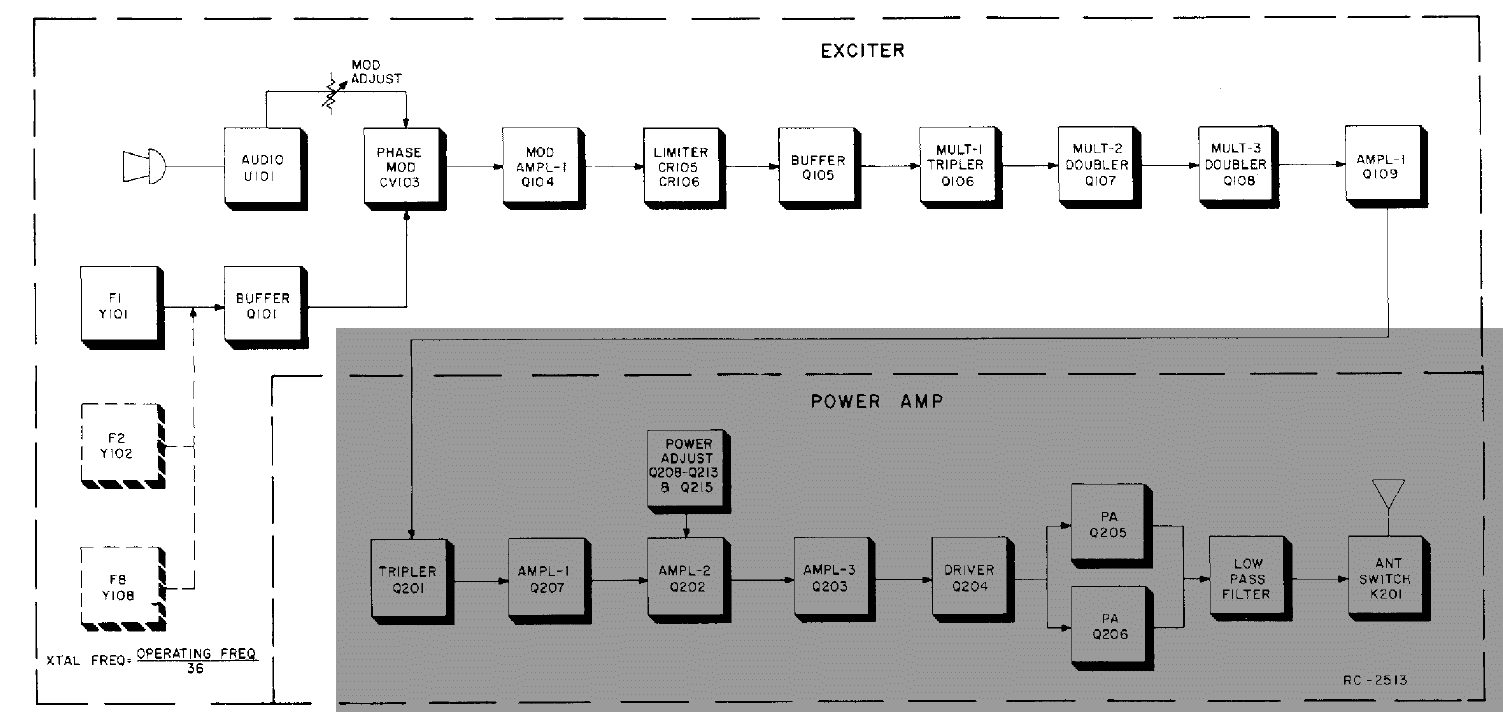
Figure2:
Signal path of the receive crystal showing the multiplier stages (highlighted).
Note that the output of the crystal is sent almost immediately to a frequency
tripler stage which allows us to inject a frequency at 3x the original
crystal frequency at that point.
Click on the image for a larger version.
As calculated above, we would ultimately need to produce a 432.80 MHz local oscillator, nominally from a crystal operating at 1/27th of this frequency, or 16.029629 MHz, and because we can actually program the Si5351A, via the ProgRock, to Hertz-level resolution,  we have the potential of being within a few 10s of Hz of the actual frequency.

If one examines the signal path (see the block diagram to the right) from the output of the crystal oscillator unit you can see that one of the first stages after the crystal unit (the "ICOM") is a frequency tripler meaning that we don't need to start at 1/27th of the local oscillator frequency, but at 1/9th - three times that frequency, or 48.088888 MHz in the example above, effectively eliminating the need for the lower frequency that would get multiplied, anyway.  In so-doing we get a bit better frequency resolution and potentially lower spurious signal generation and better phase noise response - more on that later.

Synthesizing the transmit crystal:


Figure3:
The signal path of the transmit crystal showing the modulation and
multiplier stages, highlighted.
The first stage beyond the crystal is the modulator meaning that we must
synthesize a frequency that is the same as the original crystal.
Click on the image for a larger version.
 For the transmitter, things are a bit different as can be seen in the block diagram to the left.

Instead of going directly to a frequency multiplier as in the case of the receiver, the first stage beyond the oscillator unit is the phase modulator.   For various reasons, when phase-modulating a transmitter it is best to start at the lowest frequency practical so that the small amount of linear modulation that is possible at a given frequency is multiplied along with the signal.  What this means is that we are stuck at the 12.472222 MHz frequency that we calculated, above.

Modifying a GE "ICOM":

As mentioned above, the GE MastrII uses modules called ICOMs as the frequency-determining components with these modules containing the crystal, an oscillator circuit, a tuning capacitor and some additional electronic frequency-tuning circuitry - namely a varactor diode, and some additional circuitry to provide channel selection and transmit keying.  There are three types of ICOMs commonly found in VHF and UHF radios:
  • "2C" ICOM.  This is nominally rated for 2ppm frequency stability and is typically used at UHF.
  • "5C" ICOM.  This is nominally rated for 5ppm frequency stability and is usually used at VHF.  It can provide an external temperature-based frequency control voltage that is "shared" with "EC" type ICOMs.
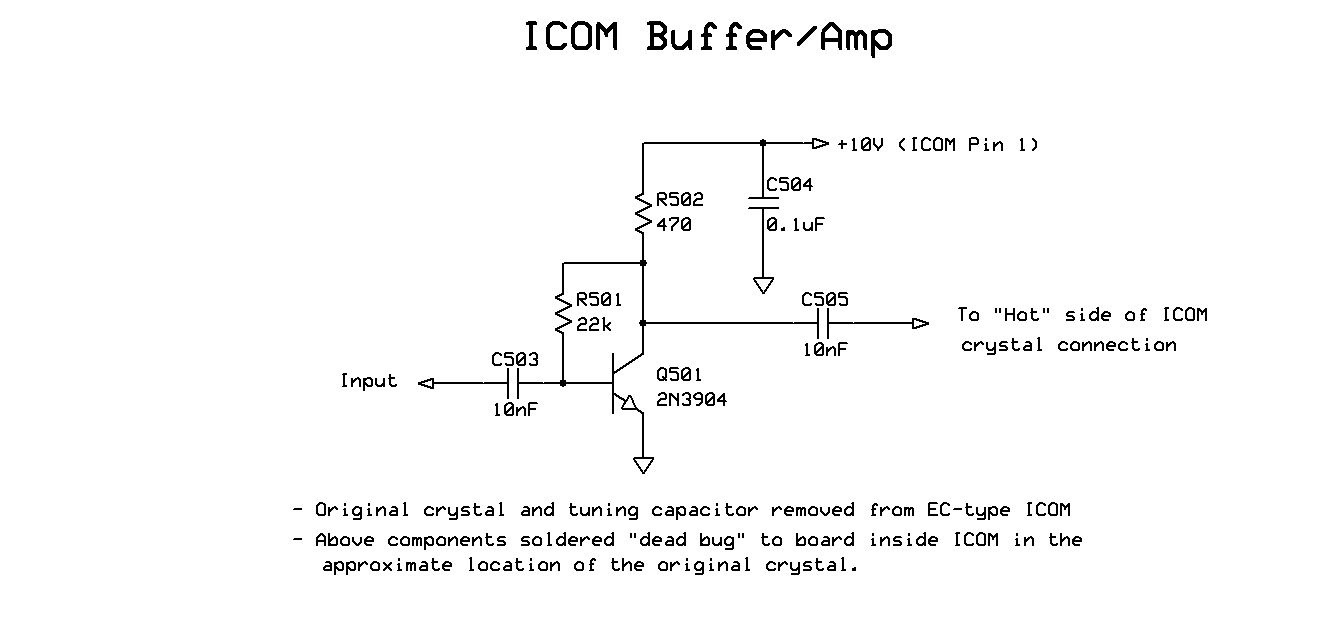
  • Figure 4:
    A buffer/driver circuit added to an EC ICOM.  This
    circuit is constructed within the ICOM unit itself.
    Click on the image for a larger version.
  • "EC" ICOM.  This "Externally Compensated" ICOM uses the voltage provided by a 5C ICOM elsewhere in the radio for frequency stability.  Normally, one would never use an "EC" ICOM all by itself as it has no temperature compensation of its own and without a 5C driving it, its frequency tuning voltage may be indeterminate.
The most common type of ICOM by far is the "EC" version - and this version is all we will use.  In terms of modification, one need only remove the original crystal and the tuning capacitor and install the buffer/amplifier circuit shown in the figure to the right.

Figure 5:
The insides of the modified "EC" ICOM with the added circuitry
built "dead bug" inside the original ICOM enclosure.  The metal
can is removed for this picture with the coaxial cable entering
through the hole that originally accessed the tuning capacitor.
Click on the image for a larger version.

This circuit, a simple common-emitter amplifier, assures that signal from the synthesizer is at a consistent level - and one that is capable of fully-driving the original oscillator circuit to full output.  While we can build a complete, new circuit for the ICOM, retaining its original oscillator circuit is a convenient means of keying the transmitter using the original PTT circuit in the MastrII radio.

While a bit cramped, there is enough room to build the simple circuit shown in the diagram above inside the original can.  When this is done, the input of the circuit and its connection to coaxial cable is arranged such that it passes through the hole originally used to access the tuning capacitor.  This circuit is insulated from the can using the "fish paper" that originally insulated the circuity and crystal from the can.

Putting it into practice:

To see if the synthesizer produced a transmit signal of acceptable quality, I decided to use a ProgRock in a 70cm transmitter.  Because of the higher multiplication factor of the UHF transmitter, this would be a good "worst case" test to determine if the spurious content of the transmitted signal was cause for concern, as well as analyze the same signal in terms of phase noise to see if the synthesis process caused additional degradation of spectral purity.

Because it was on-hand, I tested using a UHF GE Mastr II transceiver, using unshielded clip leads to connect directly to the "ICOM" socket, including a 1000pF blocking capacitor to protect the ProgRock's Si5351a chip.  The results were encouraging:  A very subtle increase in the background noise (hiss) on both receive and transmit (the TX and RX testing was done separately) but no other obvious issues.

Figure 6:
The as-built filter, using three 42IF129 10.7 MHz IF "cans".
Click on the image for a larger version.

In looking at the spectral purity of the transmitted signal, a slight amount of added noise was seen on a spectrum analyzer - well into the -90dBc range - within a few 10s of kHz of the carrier.  Farther out, in doing an "A/B" comparison with a crystal on the same frequency we saw a few low-level spurious signals, but doing some "hand waving"  (literally putting one's hand near the temporary clip-leaded wires) indicated that most of this was being picked up on the flying leads.  A visible spur was seen at +/-1.32 MHz, but this was immediately recognized as being from an AM radio station located about 1.5 miles (about 2.4km) away and had a "proper" installation been done with shielded cables, it's likely that this would not occur at all.


Making it better:

Without making things complicated, there is little that can be done about the low level hiss, largely attributed to phase noise of the synthesizer - but it's unlikely that this would even be noticeable in a typical installation, and if VHF were used instead, it may not be audible at all.  What would be prudent would be the use of a narrowband L/C bandpass filter  on the output of the synthesizer to further-filter its output and knock down farther-removed signals (and their mixing products) that might find their way into the transmitter - particularly those related to the 27 MHz reference oscillator.

Figure 7:
Schematic of the filter using 10.7 MHz IF transformers.
Click on the image for a larger version.


In the "old days" one option of filtering the oscillator output was with the use of tunable 10.7 MHz IF transformers, such as the "42IF129" that had been available from Mouser Electronics and other places as these could be tuned from below 7 MHz (with an added capacitor) to around 13 MHz with no modification - and even higher by removing the internal capacitor and using a smaller value external cap.  Unfortunately, obtaining any 10.7 MHz IF transformers these days is difficult - although several surplus and hobbyist parts suppliers still have a few on hand.

The lack of ready availability of this particular type of component means that we would need to make a similar unit ourselves - described below:

Figure 8:
An alternate version of the bandpass filter using more commonly-available components.
Click on the image for a larger version.

This filter is depicted in Figure 6, using readily-available components.  The frequency range can be tweaked as needed:  Changing the 82pF capacitors to around 100pF will allow tuning down to about 10 MHz while lowering them to 47pF will allow tuning around 14 MHz (20 meters).  This filter's insertion loss (about 6 dB) is comparable to that depicted in Figure 7, with 15-20dB of attenuation at +/- 1 MHz and at least 40dB attenuation +/- 3 MHz.

Note:  It is NOT the fact that the ProgRock puts out a square wave with harmonics that is a concern - the output frequency of the ProgRock is immediately multiplied to one of those harmonics.  Again, it's the non-harmonic low-level spurious signals that are of concern.

Implementation:

The ProgRock has three outputs available, but depending on your application you may need to deploy two of them, as noted above:

  • For half-duplex use, a single Prog-Rock could be used, one output for TX and the other for RX.  In this case one would use the available "channel banks" and program it such that for TX, only that specific output would be enabled.  For RX, one would use one of the channel bank bits to select a configuration in which the output of the TX is disabled and the output for the RX is enabled.
  • For full-duplex use, the use of TWO separate ProgRocks is recommended:  Even though it is able to output both frequencies simultaneously, the outputs of the synthesizer are susceptible to producing low-level spurious signals as these two outputs interact on the chip itself - and for this reason the isolation of two, individual units is suggested.  On a GE Mastr II repeater, the TX and RX sections are isolated anyway, so spending the extra money to buy a second ProgRock to keep it this way is strongly recommended!

Mentioned above are the "channel banks":  There are three bits available for selecting up to 8 separate configurations.   If, on a half-duplex radio, one of these bits is used for selecting the TX and RX frequencies, two other bits remain available allowing up to 4 different frequencies to be selected.  Similarly, in cases where two separate ProgrRocks are used (one for TX, the other for RX) up to 8 separate frequency configurations is possible.

Finally, the original ProgRock boards shipped with an imprecise "computer" crystal that is not temperature stable.  The newer versions of the original ProgRock had the additional footprint for a TCXO (Temperature Controlled Crystal Oscillator) that will hold the frequency to within 2.5ppm - more than adequate for 2 meter usage:  An article describing how to retrofit the unit with a 1ppm TCXO - suitable for UHF use - may be found here.

Update

The current-production "Progrock 2" - which sports a USB interface for programming - ships with a 0.25ppm TCXO so a retrofit for stability is unlikely to be required.

A word of warning:  Although it is rated for up to 12 volts, I would recommend that you do NOT operate the Progrock 2 at higher than 8 volts!

* * * * *

This page stolen from ka7oei.blogspot.com

[End]


Tuesday, February 20, 2018

Better frequency stability for the QRP Labs "ProgRock" synthesizer

NOTE:

The Progrock 2 from QRP-Labs has replaced the original ProgRock.  This device has a 0.25ppm TCXO, eliminating the problems noted below.

* * * * * * * *

Update:

It turns out that the newer (version 4) of the QRP Labs ProgRock board has pads for a TCXO.  See below for a link to the ProgRock web page.

The ProgRock:

The "ProgRock" synthesizer from QRP Labs is an inexpensive device based on the Si5131 "any frequency" synthesizer that may be used to produce up to three frequencies simultaneously - typically from around 8 kHz to around 200 MHz (with some limitations) but it may be coaxed to go down about 3.5 kHz as high as 290 MHz.

Figure 1:
The "synthesizer" portion of an unmodified Version 3 ProgRock.  The
27 MHz crystal, in the upper right quadrant, is a typical "computer grade"
device amd is typically stable to only a few 10s of PPM over a a wide temperature
range - OK for many applications, but not where you want really
good frequency stability.
Version 4 of the ProgRock has pads for an SMD TCXO on the
top of the board, although it's not the same device that I used - see text.
Click on the image for a larger version.


Typically programmable using a pushbutton and a DIP switch, newer versions of firmware may be programmed via a serial port as well.  These devices also have an input from a 1PPS (1 pulse per second) source, such as a GPS receiver, to allow precise setting/control of the frequency.

Unlike a VFO, the ProgRock produces only a set of fixed, pre-programmed frequencies:  Up to 8 "banks" of frequencies may be selected via three digital select lines.

What sort of things might this be used for?
  • Arbitrary frequency sources for the workbench.
  • Providing clocks for digital circuits.
  • The local oscillator of a fixed-frequency receiver or transmitter.
  • An internal local oscillator for a radio - such as a a frequency converter or BFO.
For casual use, the supplied crystal - a typical computer-grade unit - is adequate, but if you need the frequency to be held to fairly tight tolerance - say, a couple of parts-per-million - over a wide temperature range you will probably want something else.  QRP Labs does sell an "OCXO" version of the synthesizer which works well, but it is more complicated to build and adjust, it consumes several watts of power and produces extra heat.

You might ask:  "Why not just use the 1PPS input for frequency control?"

Figure 2:
The bottom side of the board after modification.  The tiny TCXO module
is affixed to the board and then connected to the circuit using flying leads.
In the picture above, pin "1" is in the lower right corner of the device - the
only one without a solder connection.  On the "label" side of the chip
pin 1 is identified by a very tiny dot.  Pin 2 ground (lower left, blue flying
lead) can be identified with an ohmmeter as it is also connected to the case.
Click on the image for a larger version.
While these devices can be "nailed down" to a precise frequency with the application of a 1pps input from a GPS receiver or other high-stability source, there is a problem with this option:  It tends to cause a "step" change in frequency on the order of 1-2 Hz.

Such step changes would probably go unnoticed on SSB or CW, but with certain narrow-band digital modes there might be a problem.  While modes like WSPR or JT-65 can deal with frequency drift, this would normally occur very gradually over the period of several symbols giving the decoder enough time to track, but if the frequency shift were very sudden, a few symbols would probably be lost.  While the occasional loss of data is normal, any loss caused intrinsic to the receive system - perhaps due to frequency steps of the local oscillator - would degrade the remaining error-correcting capability overall.

In other words:  If phase or very fine frequency changes will affect your communications, you might not want to use the 1PPS input.

Using a TCXO:


Another option is to replace the crystal with a TCXO (Temperature Controlled Crystal Oscillator).  These small, self-contained oscillators have on-board circuitry that counteracts the temperature-related drift, holding the frequency relatively constant over their design range.

A suitable device is a part made by Taitien and is readily available, being DigiKey part number 1664-1269-1-ND (Mfg. P/N TXETBLSANF-27.000000).  This device is tiny - only 3.2x2.5mm square so soldering to it is a bit of a challenge - but still manageable with a fine-tipped iron and some magnification.

Note:
As pointed out in the QRL Labs documentation, some TCXOs may have "stepped" frequency adjustments as part of their temperature compensation due to a built-in temperature sensor and D/A converter referencing a look-up table.  If sufficiently large (e.g. results in more than a few 10ths of Hz "step") these frequency discontinuities can disrupt/degrade modes such as WSPR that operate over very narrow bandwidths.  If a TXCO does this, the synthesizer being controlled by it will also exhibit the same frequency steps, proportional to the output frequency.

The Taitien TCXO units noted above were observed at 432 MHz (the 16th harmonic of the 27 MHz TCXO)  using signal analysis software to magnify possible frequency steps:  If such "step" behavior was happening, it was smaller than 0.34 Hz at 432 MHz (e.g. 0.02Hz at 27 MHz.)

The power requirements of this device are very low - only 1-2mA, far less than the 100-200mA of a warming crystal oven - and it may be powered directly from the existing 3.3 volt supply of the synthesizer board.  This TCXO produces about a volt pk-peak output which is in line with what the data sheets for the Si5351A suggest for a capacitively-coupled external signal being fed into the crystal input.  It is possible that the Si5351A would work just fine if this TCXO were directly-coupled, but I included the capacitor just to be safe.

Wiring the TCXO:

Comment: 
As noted above, later version of the ProgRock have pads for a TCXO, albeit one with a different footprint than above.  The device suggested by QRP Labs is the FOX924B-27.000 (Digi-Key P/N:  631-1075-1-ND) which is quite a bit larger than the Taitien device and has a rated stability of 2.5 ppm instead of 1 ppm.  This device has a higher output voltage swing which allows the omission of the coupling capacitor used with the Taitien device noted above.

I first removed the crystal and cleaned the holes of solder.  The TCXO module was then glued using cyanoacrylate adhesive (a.k.a. "Super Glue") "belly up" to the circuit board (after it was cleaned with denatured alcohol) at a location on the bottom side of the board between the synthesizer chip and the crystal position as shown with pin "1" in the lower right corner.  With the oscillator firmly in place, a small piece of 30 AWG wire was used to solder pin "4" (V+ - upper-right) to the nearby connection of C3, one of the V+ lines for the synthesizer chip.  Connected to the opposite corner (pin 2, lower left) another short piece of 30 AWG wire is connected to the other side of capacitor C3 to provide the ground.

A small, 1000pF disc ceramic capacitor was inserted into the bottom side of the board to connect to the crystal terminal closest to C3 and the "CLK 0" terminal with the other lead carefully formed and bent to be soldered to the upper-left pin, #3 - the output terminal of the TCXO.  Once the capacitor is soldered into place it is a good idea to re-heat the capacitor's other lead (the one soldered into the board) to relieve any mechanical stress that might have occurred from bending the lead to fit to the connection.

Before soldering to the TCXO - but after it has been glued to the board - it is recommended that a small amount of liquid flux be applied to the connections and that they be tinned using a hot iron with a very fine tip:  The ceramic package tends to draw away heat quickly, making it a bit difficult to solder and tinning it before-hand assures that a solid connection has been made.  Don't tin the unused pin as it's an easy way to identify the pins of the device while it is inverted.

Assuming that the connections are good and that the pins were properly identified, the synthesizer may be plugged into a ProgRock as normal.  If all went well, the output frequency will be pretty close to what it was before - but slightly low in frequency.  While the nominal frequency of the original crystal is 27.000 MHz, the frequency is usually 2-5 kHz high in this circuit so the "default" clock frequency of the ProgRock is set to about 27.003 kHz to compensate.  With the TCXO being within 1 PPM of its intended frequency, register 02 of the ProgRock will have to be set to the new frequency, hopefully within a few 10s of Hz of exactly 27.0 MHz:  If you have a means of precisely measuring the frequency, use that number for register 02, otherwise use 27.000000 MHz.  Once this is done the programmed, output frequencies will be quite close.

Once everything was checked out I put a few more dabs of adhesive on the capacitor and flying leads to make sure everything was held into place.

How well does it work?

I put together two of these TCXO-based ProgRocks and when compared to a GPS-referenced source, I found one to be 1 Hz high (e.g. 27.000001 MHz) and the other to be about 13 Hz low (26.999987 MHz) - both well within the 1PPM specification.  These frequencies were programmed into register 02 and CLK0 was set to precisely 10 MHz and I found the output to be within 1 Hz of the intended frequency.  I then heated and cooled the units and observed that the frequency stayed well within the 1PPM spec, indicating that all was as it should be.

Example applications:

Stable receiver local oscillator:

Figure 3:
An application of the ProgRock where two of the outputs are being used as
the local oscillators of two "SoftRock Lite II" receivers configured to cover
different portions of the 40 meter band.  Fitted with a TCXO, these
frequencies will be held to within 1ppm over any reasonable temperature
excursion.
Click on the image for a larger version.
An immediate need for a stable frequency source came about recently while I was putting together a module that is designed to cover the entire 40 meter amateur band in two segments using two "SoftRock Lite II" SDR receiver modules.  Normally these ship with crystal oscillators, but the use of a single ProgRock module allowed a pair of these receivers to collectively cover the entire 40 meter band with very good frequency stability - important if digital modes such as WSPR are to be considered.

Figure 3 shows the result.  Both receiver modules and the ProgRock were mounted in the lid of a Hammond 1590D die-cast enclosure and a simple 2-way splitter using a BN-43-2404 binocular core was constructed.  The end result - when coupled with good-quality 192 kHz sound cards - is a high-performance, stable receive system capable of covering the entire U.S. 40 meter amateur band - with a bit of overlap in the middle and extra coverage on the edges.

Replacement of a crystal in a phase-modulated VHF/UHF transceiver:

These days it is increasingly difficult to source custom quartz crystals for older "rockbound" commercial radio gear.  An example of this is the GE MastrII line of VHF (and UHF) transceivers that require a crystal for each transmit or receive frequency.  Even though this equipment is now quite old, it is still useful as it is quite rugged and has excellent filtering and when properly prepared, it has been proven to very reliable.

These radios use crystals in the 12-13 MHz area for transmit and 16-17 MHz area for receive so a ProgRock can be easily programmed to be used in lieu of a crystal with a slight modification of a GE "ICOM" channel element.  Because the MastrII transmitters use phase modulation, the signal source is never modulated - and this is an advantage if you happen to need to set several overlapping transmitters to the same frequency and you need their modulation to "track" precisely.  By using a TCXO (or QRP Labs' OCXO) rather than the 1PPS to maintain frequency stability, the possibility of occasional "clicks" in the audio due to frequency correction steps is eliminated.

Comment:  For "Direct FM" radios like many older Motorolas, a ProgRock cannot be used as they require that the oscillator itself be modulated, and this is not possible with a ProgRock.

With any synthesizer the concern is that it will produce spurious signals and/or additional phase noise that will degrade the transmit/receive performance, but preliminary testing has shown that even when multiplied to 70cm, the resulting spectra is quite clean - probably good enough to be used on a repeater.  If one does do this, there are a few things that should probably be kept in mind:
  • Even though the ProgRock can output two frequencies at once, there is a small amount of crosstalk between them and when multiplied to the ultimate VHF/UHF frequency, these low-level spurs could end up on the output.  For this reason it would probably be a good idea to use two separate ProgRocks, located physically apart from each other, in a full-duplex radio.  For half-duplex, a single ProgRock could be used with the RX and TX frequencies being toggled by selecting a pre-programmed "bank".
  • Its worth noting that in many of these radios the LO frequency of the receive frequency is immediately multiplied by the next stage.  Testing was done on a receiver showing that the ProgRock could be set to the output frequency of this multiplier stage.  This cannot be done for the transmitter as the oscillator's output is immediately phase-modulated at its operating frequency.
  • It would probably be a good idea to place some high-Q band-pass filtering tuned to the synthesizer's output frequency to minimize any low-level spurs at frequencies removed from the main output frequency that might be present on the synthesizer.  Initial testing didn't show any obvious problems, but using such a filter would be a sensible precaution.
  • A very small amount of added "hiss" - probably from low-level phase modulation - was observed at UHF.  In normal use, this would probably have not been noticeable unless one did an "A/B" test. With the phase noise being lower at VHF, this hiss would probably be unnoticeable.

[End]

This page stolen from ka7oei.blogspot.com