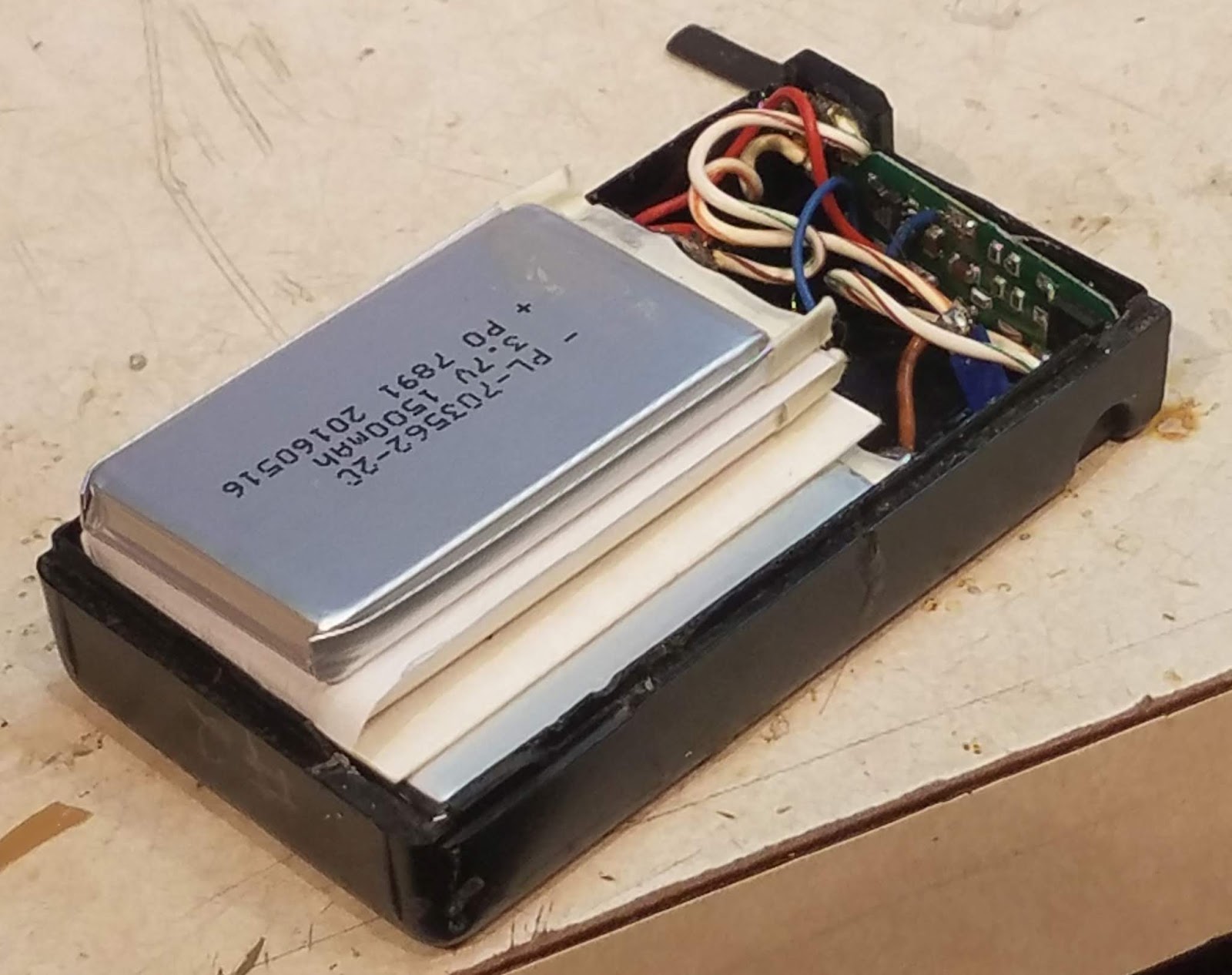
Nickle-Cadmium (NiCd) and Nickle-Metal Hydride (NiMH) cells are ubiquitous, but their behavior in typical consumer items is not at all well understood by most people. Much of this is because one never thinks about what is powering that portable device until it stops working, but a lot of it has to do with confusing advice and misinformation about them and how they behave.
Another problem is that in long term, NiCd cells
can have
longer life spans than NiMH cells, but why is it that in so many applications people find that the NiMH cells outlast the NiCd cells that they used to use?
We'll answer
that question along the way.
The economics and convenience of rechargeable cells:
Even if they don't last very long (in terms of years) rechargeable cells are almost always much less expensive to own and operate than their non-rechargeable Alkaline cousins, but there is a convenience factor involved:
- You can probably get more run time (from many - but not all - devices) from a set of alkalines than you can from a single set of rechargeables.
- When you put in a fresh set of alkalines, you have a pretty good idea how long that device will run. Unless you pull rechargeables off the charger - and you know that they are good, you don't know before-hand how long the device will run.
- A set of alkalines can sit around in the package, unopened, for several years and still be good. Again, with rechargables you don't know their charge state for certain - particularly if you haven't used them for a while!
Based on the above, one might be understandably wary about using rechargeable cells, but for many devices - such as portable power tools - there's really no option!
Alkaline Cells: A comparison to NiCd and NiMH:
Other than the fact that they are rechargeable, what are the main differences between alkalines and NiCd/NiMH cells? As it turns out, voltage isn't really an issue since modern devices will happily run at 1.2 volts per cell - the same as NiCd/NiMH and a half-discharged alkaline.
What about capacity?
A good-quality alkaline AA cell has a capacity of about 2.5-2.8 amp-hours. Comparing an AA-size NiCd, its capacity will be in the area of 0.6-1.1 amp-hours and a NiMH will have a capacity of between 1.8 and 2.8 amp-hours, depending on the brand and specific type. In general, the rechargeable cell will have
less capacity than the equivalent sized alkaline, but why is it often the case that it runs an electronic device longer?
Internal resistance is the answer. When fresh,
the internal resistance of a good-quality AA alkaline cell is on the
order
of
0.15 ohms per cell, increasing to 0.3 ohms per cell when the it is 50%
discharged and over an ohm when 80% discharged! If your camera uses a battery of 4 cells in series that means
that the total resistance of new cells (excluding resistance of battery
contacts and wiring) is about 0.6 ohms, rising to 1.2 ohms when the
battery
is just 50% discharged - and it only gets worse
(much worse!) as the it is further-depleted!
If the digital camera consumes, say, 800 milliamps (a reasonable
amount
when a flash is charging, a backlit display is operating, etc.) then
cell
resistance alone will dictate a voltage drop of 0.48 volts for a
battery
with new cells, and 0.96 volts or so for cells that are 50% discharged.
Again, this does not take into account other resistive losses -
such
as contacts and internal wiring - some of which can be significant!
For new cells in a 4 cell battery, this voltage will (optimistically
- assuming a nominal 1.5 volt unloaded output) amount to about 5.5
volts
under these conditions, dropping to about 4 volts when the cells are
50%
discharged - a voltage that
may be inadequate for operation of
the
camera.
There is yet another problem. Often, cameras contain
switching-type
voltage converters. While these are efficient in their energy
conversion,
they attempt, by their nature, to maintain a constant
power
output
over a varying input voltage. What this means is that, as the
battery
voltage drops, the
current consumption will
increase as
the
voltage converter attempts to maintain the constant voltage output -
exacerbating
the problem of already-low voltage and resistance. This problem can get worse
when
the camera's load changes because of a charging flash, a backlit
display
being illuminated, or the camera's CPU pulling more current when
processing
the image and saving it to memory.
In other words, the cells may be, say, only 50% discharged, but the
equipment (the digital camera, in our example) may simply be unable to
use the energy that is still available. If this is the case
you'll
probably get plenty of life out of those same batteries if you put them
in a small flashlight or portable FM radio, or TV remote control.
In
other words - don't throw them away just yet!
NiMH, NiCd cells and internal resistance:
NiCd and NiMh cells, on the other hand, typically have a much
lower
internal resistance over their charge life and under typical conditions, this resistance is typically lower than that of an
alkaline
cell - even when the NiCd or NiMH cell is significantly
discharged.
According to info from several well-known manufacturers,
a relatively new AA NiMH cell typically has about 0.17 ohms per cell
when fully charged (as opposed to 0.15 ohms for a "fresh" Alkaline AA
cell of good quality) but this rises to just 0.18 ohms at the "100% discharge"
point.
As we demonstrated above, a typical AA Alkaline cell can be expected have
over an ohm of internal resistance at 80% discharge -
and this value skyrockets as the battery is discharged further!
From what information that I have been able to find, a typical NiCd
seems to have about
half the internal resistance of the same-sized NiMH cell
and is one of the factors that explains its suitability in very high
current situations.
What this means is that while an alkaline cell may be able to run
the
digital camera (our example from above) only until the cell is at its
50%-70%
charge level, a NiCd or NiMH battery can probably output the required
current
and voltage until it is at or below its 15% charge level. The
lower intrinsic resistance also means that they are more likely to be
able
to tolerate impulse loads (i.e. additional current drawn by the flash
charging,
for example) without causing the camera to shut down due to low
voltage.
Comment:
At the current level of technology, NiCd
cells are often preferred over NiMH cells for certain applications, most
notably those requiring very high current consumption such as in
battery-powered tools, etc. In these applications, the high
current drawn by the tool would over stress a typical NiMH cell and
likely result in shorter operational and useful life than a NiCd cell.
There are NiMH cells that are specially designed for "high drain" applications, but these are special purpose cells that often trade this high current capability for capacity, putting their amp-hour ratings below those of other types of NiMH cells.
When cells go wrong: "Memory"
One of the best-known properties of NiCd cells is this thing that
people
refer to as "Memory" - that annoying property of cells seeming to go dead much sooner than expected.
It is unfortunate that this effect. while called "memory" by many people (and some manufacturers of electronic devices) is almost never that phenomenon that is really the "Memory Effect." Instead, this phenomenon is usually due to cell damage caused by reversal - more on this later.
One of the first places that the so-called "memory effect" was first
noticed and quantified was when
NiCd cells were first used in communications satellites. These
satellites
rely on solar panels for their power, but the Sun is eclipsed by the
Earth
at times and it is during these periods that the satellite must operate
from battery power alone. For many satellites these eclipses were typically of very
similar
duration which means that
during the "eclipse season"
the
battery was run down by about the same amount, time after time.
The "memory" was noticed when, after several eclipses, the battery
voltage
would relatively quickly drop to the voltage approximately that attained during the latter
part of the eclipse - and typically stay there. It was also noted that this "memory" effect could be reversed simply
by charging the battery and then discharging it to a
different
point
for several cycles and was done by clever management using
multiple
battery strings onboard the satellite and preventing a battery string
from
being discharged to the same point repeatedly.
It is important to know that little (or no)
permanent
damage was actually done to the cells by this "memory" effect - the
result
was (more or less) a
temporary reduction in the cells' capacity
until they were conditioned appropriately.
In typical use by consumers who use NiCd-operated devices, it is
unusual
to discharge the battery to
precisely the same point
time-after-time. Typically, the amount of discharge is somewhat random - and just one or
two
variations from a precise cycle will largely "erase" a weak memory effect.
Among
the
very few documented cases of "terrestrial memory effect" were
been in pager service where, regular as clockwork, the batteries would
be run down during the day and recharged overnight. This was a
long
time ago - back in the days when pagers were those half-brick sized
things
that only VIPs and doctors wore - and batteries only lasted a day or
two
anyway!
It has been reported that NiMH cells can also exhibit this same
"memory" effect - but remember that it is atypical to expose a cell to
very precisely repeated discharges of equal depth time after
time: Most people just don't use their battery-operated devices
that way!
"What is this thing (mis)called
'Memory'
then?"
Abused NiCd cells will typically exhibit a loss of capacity and/or
the
inability to take or retain a charge, and it
this
property
that is too-often misidentified as "
memory." But,
this
is
not "memory."
What
is going on,
then?
Cell Reversal:
Good quality battery packs are made from individual cells that have
been matched in terms of resistance and capacity. This is
important
in terms of maximizing battery life.
Here's why:
A battery typically consists of cells wired in series for higher
voltage.
Ideally, all cells will run down at exactly the same
time.
This is not usually the case, however, especially as the cells
age and some get weaker faster than others.
Temperature also has a large impact on cell longevity. A cell
that
is operating at a higher temperature will generally have a shorter
overall
lifetime than one that is cooler. An effect of this can be noted
in a large battery pack (such as that on a cordless drill) in which a
large
number of cells are grouped together. Often, the cell(s) in
the "middle" of the pack die first as these are surrounded by
other cells. Not only can these "inner" cells not get rid of
their own heat
as easily as those cells on the "outside" layer of the pack, but they
are
also exposed to heat from the cells that surround them!
How
important is heat to the life of a cell? One oft-quoted statistic
(that I've not verified personally with NiCd cells) is that for every
ten degrees F of temperature rise above 80 degrees F, the usable
lifetime of the cell will be halved! Even if these numbers aren't exactly
correct, cells that are warmer
will die sooner!
Inevitably, one or more cells will run down sooner than the rest and
its voltage will drop. Because the
other
cells
still have some charge, current is still flowing through it and
the now-dead cell's voltage will not only drop to zero, but it can go
below
zero and effectively start to "charge" backwards because at least some of the remaining cells are still outputting voltage.
The effect of this is a very quick death to a NiCd cell!
Why?
It comes down to chemistry. When a NiCd cell is
reverse-charged,
a strange thing happens: Conductive metallic "hairs" (often
called
dendrites)
begin to form - and they "grow" from one electrode to another.
Eventually,
this dendrite forms a short across the cell - one that can have a range
of resistance from high to low, depending on the severity of the
damage and the size of this dendrite.
Once this dendrite has formed in the NiCd cell it is
permanent
and
cannot
be "dissolved" by charging the cell correctly or by doing any sort of "conditioning." Furthermore, this
dendrite can form a leakage path that can cause the cell to run down by
itself - the rate at which can vary depending on the resistance and relative size of the
dendrite. The effect can range from a cell that just doesn't
"hold
a charge as long as it used to" to or, in extreme cases, the dendrite may
be big enough that the cell won't even seem to take a charge at all
(except,
maybe, on a "quick charger.")
Perhaps the
worst thing about the dendrites is that
they
represent an amount of electrolyte that can
no longer be
used to contribute to the charge capacity of the cell. What this
means is that not only is the cell likely to run itself down more
quickly
because of charge leakage due to the dendrite, but even if it is fully
charged to begin with it will be the first in the battery pack to run down next time it is used
and
go into reversal -
again - and will be prone to forming
even more, bigger,
and
better dendrites!
(In other words: A vicious little
circle...)
Note: NiMH cells do not seem to exhibit this
"dendrite
growth" problem, but cell reversal tends to cause gasses to be
generated. If these gasses are produced as too high a rate, they
cannot be reabsorbed internally and pressure will build within the
cell, causing outgassing when the safety vent releases and resulting in a permanent loss of cell
capacity.
"ZAPPING" NiCds:
You may have heard about a technique for "restoring" NiCds often
referred
to as "Zapping." As the name implies, one dumps a brief surge of
energy into the cell and, almost as if by magic, the cell is "restored"
to operating condition.
Well, not quite!
The surge of energy should be limited - often, a "zapper" consists
of
a very large capacitor (50,000 to 200,000 microfarads) charged to
50-100
volts, the source voltage disconnected, and the energy of this
capacitor is dumped into a cell via a
very
heavy switch or a beefy SCR. This "one shot" burst of capacitor-stored power prevents
too much energy from being dissipated by the cell and blowing it (and
the
person doing the "zapping") up.
Another method uses a lower
voltage
- but much higher current - say, from a large power supply: The
obvious disadvantage of this
latter
method is that it is not "self limiting" as is the one-shot nature of
the capacitor discharge and one can easily "pop" a
cell
either by burning open internal conductors or cause the cell to
rupture
due to a sudden buildup of heat and gasses. Needless to say,
neither
situation (especially the latter) is particularly desirable!
What is supposed to happen in this process is that enough energy
applied to
"fuse"
(or blow away) the dendrite that is shorting (or "almost" shorting) the
cell. Once this low-resistance path is removed, the cell can be
charged again. This doesn't completely remove the dendrite, but "disconnects" it (hopefully) but it still represents a degradation of the cell.
It should be kept in mind that such a "repaired" cell, although it
may be more
able to take a charge than before, will still have reduced capacity
and,
when used in a battery, is still very prone to discharging early and
going
into reversal - again.
Remember: The
material
that formed the dendrite no longer contributes to the charge
capacity
of the cell - even after you "zap" it. Furthermore, the cell
contains
a separator material that will often be damaged by dendrite growth and
"zapping" - something that further contributes to
self-discharge.
If you do this technique, make sure that you have completely
disconnected
the cell/battery from the appliance being operated to prevent the
voltage
surge from the "zapping" process from damaging it.
Finally, while
you may get some additional use out of a battery as a result of
"zapping" I consider that "zapping" a cell may
simply be buying me enough time
to get a replacement ordered and on its
way!
Note:
It should go without saying that this
"zapping"
procedure
can be hazardous: Not only are potentially
dangerous
voltages and currents involved, but there is a chance that the cell may
explode and/or leak hazardous material.
Finally, this procedure should be done only on an individual cell and not the entire
pack
at once - That is, you must be able to access and test each cell
you
plan to "zap", individually.
Getting the most out of your NiCd/NiMH cells:
For reasons unknown to me,
some
manufacturers
of battery-operated equipment recommend that you "condition" NiCd
battery
packs by running them completely down, and then charging them
again.
I guess that the claim is to prevent a "memory" condition from
occurring
- but it is already known that to cause this "memory" the cell would
have
to be
precisely depleted to exactly the same charge state
repeatedly:
This just
doesn't happen with most people's usage of equipment.
Why do they make this recommendation, then? The cynical side
of
me says that they are just trying to sell more batteries or
devices:
By recommending you go through some steps that are guaranteed to
shorten
battery life, they can increase sales! The other side of me would
guess that the person writing these instructions is just poorly
informed
or just doesn't know any better.
Here are a few things you can do to prevent premature failure of
NiCd
battery packs:
- NEVER, EVER run a NiCd battery pack completely down.
Inevitably,
one
or
more
cells
will
go
into reversal before the others, immediately causing permanent
damage to the cell(s). The only safe way
to
run a NiCd battery pack completely down is to guarantee
that no cell can possibly go into reversal. This
can
only
be done by monitoring each individual cell and
preventing
reversal by bypassing it - but almost no manufacturer of consumer goods does this due to
cost and complexity. NiMH cells aren't
totally
forgiving either: While they may not be immediately
damaged
by reversal, such operation can result in loss of capacity due to
outgassing. (Note: Rechargeable lithium-ion
packs
use exactly this sort of protection because Li-Ion cells are completely
unforgiving
of a complete discharge/reversal.)
- DO NOT try to drill that "last hole." Have you
ever
been using
a cordless drill when, just before the battery goes completely dead, it
suddenly slows down and loses most (but not all) of its
power?
At that moment, one or more cells have collapsed and are going into
cell
reversal. Your battery pack will last much longer
if
you stop using it the instant that the motor slows due to the
voltage
drop. Unlike alkaline cells, NiCd and NiMH cells will put
out (more or less) the same voltage until they are almost totally dead
- at which point their voltage will suddenly drop. Again, if NiCd
battery
packs had the same sort of circuitry in them that Lithium-Ion battery
packs
did (e.g. a circuit that "disconnects" the pack when any one or more
cells'
voltage drops too low) they would, on average, last much
longer.
- Do not overcharge the cells. Nowadays, "smart
chargers" are
pretty good about preventing cell overcharge, but if a battery pack
gets
unusually hot, something may be wrong. So-called "trickle" chargers
won't
destroy a battery pack too quickly if they are left connected after the
battery is fully charged, but it isn't a good idea to leave it
connected
forever. If the battery is noticeably warm when connected to
a
trickle charger, it is already overcharged. Overcharging NiCd
or NiMH cells can cause gasses to form in the cell's electrolyte and
if
this pressure builds up, a safety vent in the cell can open (which is
better
than having the cell explode...) and the gas will be vented. This
venting represents a loss of material - which also means a loss of cell
capacity. Another phenomenon that can shorten life of a
trickle-charged
cell is the breakdown of the plastic separator due to its continuous
exposure
to oxygen at elevated temperatures.
- Don't leave the pack on the charger and walk away! Related to the above, it is a terrible idea to leave a battery on a charger all of the time. If you can detect any warmth from the battery when it is left on the trickle charger for a day or so, it is being trickle-charged too strongly! Unfortunately, it's very easy to "charge and forget" many power tools and slowly kill the pack. Of course, there's the desire to have the portable device always at the ready, so the temptation to leave it on the pack is almost irresistable!
Interestingly, I hear from many people about the battery pack of their (whatever it is) suddenly dying - that is, seeming to have abruptly lost "run time". In general, it is the nature of NiCd and NiMH cells to maintain a more-or-less constant voltage until it is (pretty much) dead, at which point it will suddenly drop off. It is often the case that even a cell in poor shape will behave this way and the device will work properly for a while, but it is only when the run time becomes annoyingly short that one is really aware that there is a problem - particularly if it's a device such as a portable drill or vacuum that isn't normally run for long periods at a time. In other words, it's usually the case that the battery has been sub-par for a long time, but it just wasn't noticed!
The differences in using NiCd and NiMH cells:
At first glance, it would seem that NiMH cells are just "better"
versions
of NiCd cells as they have the following advantages:
- Their energy density is better: A NiMH cell has more charge
capacity
than the same-sized NiCd.
- They do not contain Cadmium - a toxic heavy metal - and thus do
not
pose
as much of a disposal problem.
- They are (apparently) not prone to forming dendrites when they go
into
reversal - something that can kill a NiCd by shorting it out internally
and/or raising self-discharge current - not to mention loss of capacity.
NiMH cells have a few disadvantages as compared to NiCds:
- Their lifetime with respect to the number of charge/discharge
cycles is
lower (250-500 for NiMH versus 500-1000 for NiCd - but this is
improving)
- They have a relatively high self-discharge rate: Just
sitting
around
they tend to run themselves down more quickly - especially as they age.
- They have a slightly higher internal resistance and a lower
current-carrying
capacity than an equal-sized NiCd: This generally makes them inappropriate
for use in high-current drain devices such as cordless power tools
where
the load may be several "C" (i.e. 2-3 amps of load per amp/hour of
cell.)
Newer types of NiMH cells are beginning to appear that do not have
quite
this limitation.
- It is more difficult to tell when NiMH cells are fully charged
than
NiCds. When NiCds are nearly fully charged, the voltage suddenly
rises - and then starts to go back down again when an overcharge
condition is approaching. NiMH cells will do this, but the
magnitude of this voltage rise is only a fraction of that of NiCd cells
and, under many charge conditions, may go completely unnoticed, hence
the need to monitor the temperature of NiMH cells as well as to limit
the amount of time over which a charge is applied.
In practical terms, a NiMH cell may actually
outlast a NiCd
in terms of charge cycles even though they supposedly have fewer
charge/recharge cycles.
Why?
Again, a
lot of NiCd cells
"die" due to cell reversal (
see above) and the resultant
effects while
NiMH cells do not readily form dendrite shorts when they go into
reversal.
Damage to a NiMH cell may still occur, though: Cell reversal
of a NiMH cell causes
gases to form and it is possible that pressure will
build up faster than its chemistry can reabsorb these gasses and the cell will vent. The resultant loss of gas means
a loss of electrolyte material and a subsequent loss of capacity.
Self Discharge:
Even without loads, all cells slowly lose their charge over time as
the cell's chemistry slowly changes. In all cases, the rate of
self-discharge increases dramatically as temperature also increases.
Comparison of self-discharge rates of various types
of cells
The table below shows the approximate amount of time that it takes to
lose 10% of the cell's capacity at different
temperatures.
Cell
Type |
0C
(32F)
|
20C
(68F)
|
40C
(104F)
|
60C
(140F)
|
| Alkaline |
>15 yrs. |
4 yrs. |
18 mo. |
3 mo. |
| NiCd |
3 mo. |
1 mo. |
14 days |
5 days (A) |
| NiMH |
1 mo. |
10 days |
5 days |
1-2 days |
Zinc
Chloride |
6 yrs. |
2 yrs. |
10-12 mo. |
2-3 mo. (A) |
| Li-Ion (B) |
- |
1-12 mo. |
- |
- |
| Lithium-Fe-S |
>20 yrs. |
>20 yrs. |
4 yrs. |
1-2 yrs. (A) |
| Lithium-Mg-O |
>15 yrs. |
10 yrs. |
3 yrs. |
1-2 yrs (A) |
These are typical values for new cells, published by various
manufacturers. Note that aging/mistreated cells will probably
exhibit
much higher self-discharge rates.
Notes:
A - Storage or use of this type of cell at 60C
violates the manufacturers recommendation for consumer-type cells and
one may expect poor lifetime. It is not recommended that any
cell be exposed to such high temperatures for an extended period of
time.
B - The self-discharge rate of LiIon cells varies widely
according to its chemistry and manufacturer. Information on
self-discharge rate at temperatures other than 20C was not available at
the time of writing but, as in the case of other types of cells, it
increases dramatically with increasing temperature and the age (and
past use) of the cell.
|
The chart above compares various cell chemistries and their
approximate rates of self-discharge showing how quickly one can expect to
lose
10% of the cell's capacity. Please note that these
rates are typical published specifications by various manufacturers
and, in the case of rechargeable cells, represent the sort of
performance that may be expected from
new cells. In
general, independent testing has shown that the manufacturers'
specifications concerning self-discharge are more-or-less in line with
what is actually observed. Also, reduction of self-discharge is
one of those parameters on which the manufacturers are continually
improving.
As can be seen the clear winners are the
non-rechargeables and the two cheapest type are the alkaline and Zinc Chloride (the so-called
"heavy duty" batteries) which do a respectable job of retaining their
capacity over time. Ahead of the pack are the non-rechargeable
Lithium types (The Lithium-Iron Disulfite and the Lithium Manganese
Oxide) and these two chemistries also perform better than the others
even when they are very cold.
The
worst of the bunch is clearly the NiMH cell which could easily
be found dead after having been left in a vehicle for a month during
the summer (if you have hot summers, that is...) It is certainly
worth repeating that NiMH cells are
NOT the proper
choice for your car flashlight, for example, or even for
any
item that is left idle for months at a time and is then expected to
work (such as an emergency radio.)
What about putting cells in the freezer to "keep" them?
For the non-rechargeable types, it can be seen that freezing them will
certainly slow the self-discharge rates, but if you plan to use them
within a year or two you'll probably
not see any real
difference in longevity of those stored in your freezer and those
simply kept at room temperature.
What
is clear
from this chart is that you should
not be storing them
in your attic or garage - or anywhere else that may tend to get
warm: It is preferred that they be stored simply in a cool
location (such as a basement) as compared to a warmer room or a vehicle.
Replacing NiCds with NiMH cells:
Can you simply drop NiMH cells in place of NiCds?
It
depends.
For
optimal cell lifetime and performance under ideal
conditions, the answer is
probably no.
For "good" performance (that is, where overall
lifetime
and charge capacity will probably exceed that of NiCd cells) the answer
is likely yes -
as long as a few rules are observed:
- You (probably) can't/shouldn't use NiMH cells in very high-current devices such
as
power
tools. These sorts of demands on the cells will result in a very
short lifetime and could be hazardous due to cell overheating and
venting. Again, there are certain types of NiMH cells designed especially for this type of service but you will have to do research on where to find them and if they will, in fact, be suitable for your intended application!
- A NiCd-only "smart charger" or "quick charger" may
not
be able
to detect when a NiMH cell is fully charged. This could
result
in undercharging (the cell isn't charged completely) or (more likely)
overcharging and "cooking" the cell if the charger cannot detect a full-charge
condition.
Make sure your quick charger is specifically designed for
charging
NiMH cells before you use it.
- Charging a NiMH cell from the original NiCd "slow" charger
should
work, but it will probably take more than twice as long
as
it did with the NiCd charger. Typically, "slow" chargers will
charge a NiCd pack in 12-16 hours, but this means that the same
charger
will probably take 30-36 hours to charge the NiMH pack. This
extra
charge time is required because the storage capacity of the NiMH cells
are likely to have at least twice the capacity
of same-sized
NiCd cells that they replace.
If you replace NiCd cells with NiMH cells there are a few things that
you
should keep in mind:
- Dispose of the dead NiCd cells properly - do not just throw them
in the
trash. Do a bit of research and find out where to dispose of the
dead cells. (Your local recycling or trash-collection agency can
probably tell you where to go... so to speak...)
- Take note of the guidelines in the above section when you charge
NiMH
cells:
They may not charge properly in a "smart" or "quick" charger and a slow
charger will take much longer to charge NiMH cells.
- They have a much higher self-discharge current (see the chart
above.) If you
charge the
battery pack and forget about it, do not expect it to
still
be charged months later!
It should be remembered that one of the main reasons why NiMH cells
seem to last longer than their NiCd counterparts is just that they can better-tolerate the abuse typically inflicted upon them. At the risk of repeating myself, here are some examples:
- In a power tool: Continuing to use it after one or more of the cells in the battery have gone dead and it slows down. This is guaranteed to very quickly kill ANY NiCd cell!
- Putting it on a charger and walking away: For a number of reasons, NiMH cells seem to be better-able to tolerate this sort of abuse than NiCd's, but it is still a bad idea! If any rechargable battery pack is noticeably warm after being fully charged and is left in the charger, it is already overcharged and is likely being (slowly) damaged!
What could manufacturers (and you!) do to prolong NiCd/NiMH
cell life?
Again, it somewhat irks me that the appliance manufacturer's recommendation
(i.e. to completely discharge a NiCd pack) is precisely the thing that
can kill NiCd cells prematurely due to the inevitable reversal that will occur in a series-wired battery pack. What is so terrible about this
is
the cost of replacement and inconvenience that results: Often,
the
user will simply throw away the entire appliance and effectively wasting money!
There are several things that could be done to greatly lengthen cell
life of both NiCds and NiMHs:
- Don't recommend that the batteries be completely
discharged. Ever!
There is absolutely no need for this in most cases. Most often, one
cannot completely discharge a pack without causing permanent damage from cell reversal! Again, NiMH cells are more resistant to damage due to reversal.
- Build into the packs (or the appliance) a device that will cause
current
consumption to cease if any cell drops below, say,
somewhere
between 1.0 and 0.6 volts. This will prevent cell reversal from ever
happening in the first place. An example of this sort of
protection
is found in all Lithium-Ion rechargeable battery packs because allowing them to be run completely down and then recharged constitutes a very real safety hazard!
Ironically, NiCd cells are, by their nature, some of the most reliable, long-lived rechargeable cells around and will far outlast NiMH and standard (rechargeable) LiIon cells in terms of longevity and the number of charge/discharge cycles - but
only if they are treated properly! It is through abuse due to allowing them to be "reversed" and being grossly overcharged that they have developed an undeserved reputation for being unreliable!
For a longer version of this article with links to related pages, go to the "About NiCd and NiMH rechargeable batteries" - link web page.
[End]
This page stolen from ka7oei.blogspot.com