Sunday, November 1, 2015

Adding FM to the mcHF SDR transceiver

This has been one of those "Rabbit Hole" features.

In the past I have stated several times on the Yahoo Group that I would not be adding FM to the mcHF (a completely stand-alone QRP SDR HF transceiver) any time soon, mostly because I was quite certain that there was simply not enough processor horsepower to do it properly, but quite recently I (sort of) got obsessed with making it work, going from "0 to 60" in just a few evenings of code "hacking".

While it took only an hour or so to get the FM demodulation and modulation working it ultimately took much longer than that to integrate the other features (subaudible tone encode/decode, etc.) and especially the GUI interface with everything!  By the time I was done I'd spent more time than I had hoped (not unexpected!) but at least had something to show for it!

FM on an HF transceiver:

First of all, FM is one of those modes that I have used on HF only a few dozen times in my 30+ years of being a ham - using it most often (albeit rarely) when 10 meters is open and I hear a repeater booming in, but other than that I haven't really had any reason to do so, particularly since there are no local 10 meter repeaters and local activity on "10 FM" is quite sparse.

Figure 1:
Reception of an FM signal as displayed on the waterfall (using the
"blue" palette) showing the sidebands from the 1 kHz tone
modulated onto the carrier being received.  The white background
on the "FM" indicator shows that the (noise) squelch is open.
Click on the image for a larger version.
What might be a practical reason to add FM to the mcHF other than for 10 meter openings or with a transverter (or a modified radio) on a higher band such as 6, 4 or 2 meters where FM is common?  I asked this question on the mcHF Yahoo group and several people noted that in various parts of Europe, FM repeaters and simplex operation on 10 meters is/are (apparently) more common than here in the U.S - not to mention the fact that I suspect that some mcHF users like to hang out on "CB" frequencies where FM is used in Europe.

Background:

As it turns out I was recently adding/fixing some of the current mcHF features, streamlining some code and I decided to look into what, exactly, it would take to demodulate FM.

Before I begin the description it should be noted that the mcHF, in FM receive mode, must utilize "frequency translation" which shifts the local oscillator by 6 kHz - this, to get away from the "0 Hz hole" intrinsic to many SDR implementations that down-convert the RF to baseband:  If we did not do this the FM carrier would land in this "hole" and hopelessly distort it!

With the signal to be received centered at 6 kHz at the input of the A/D converter, a software frequency conversion shifts it back to "0 Hz" where, in the digital domain, the hole does not exist.  True, the FM signal is now modulated +/- zero and includes "negative" frequencies, but since the signals are quadrature and it is just math at this point we can get away with it!

(Note:  The "0 Hz hole" still exists but is now 6 kHz removed from the center of the carrier so it has no effect at all on demodulated signals in receive bandwidths up to 12 kHz.)

The PLL method of demodulating FM:

The most common way to do this is via a PLL, implemented in software
Figure 2:  PLL implementation of an FM demodulator

Depicted in Figure 2 this works by "tracking" the variations of the input signal's frequency using the PLL:  Differences in instantaneous phase are detected, applied to the VCO's tuning line via the Loop Filter.  The loop filter is present to remove the energy from the original carrier frequency, effectively leaving only the audio modulation behind, a sample of which is high-pass filtered to remove the DC content and used to extract the demodulated audio.

In hardware this type of scheme is used in PLL ICs such as the NE564 and NE565, or even the good old 4046 PLL IC:  Many implementations of hardware-based FM demodulators may be found on the internet using these chips!  (Hint:  Google "NE565 SCA decoder").

In software this method would typically be applied in those instances where the "carrier" frequency was high, compared to the highest modulated frequency contained in the FM signal to be demodulated and the "VCO" would be an NCO (Numerically Controlled Oscillator) - essentially a software-based DDS (Direct Digital Synthesis) "oscillator."  In a typical SDR application the implementation would appear more complex than in the above block diagram, using both the I and Q channels as part of the phase detector (and to avoid ambiguity since both are needed to avoid the "frequency image" anyway) - but the intent is quite clear.

Out of curiosity I decided to implement this on the mcHF, but as expected it was to "expensive" in terms of processing power - plus, the "carrier" frequency (in software) was only 6 kHz - not too far above the highest modulated frequency.  I could hear the audio, but it was somewhat distorted.

The "arctangent" method of demodulating FM:

Applying another tactic I went for the "arctangent" method.  If you recall your trigonometry, the arctangent is that number that you get when you input the ratio between the two sides of a triangle to yield the angle.  Related to the arctangent is the "atan2" function that appeared in computer languages where not just the ratio is inputted to the function, but the actual lengths of the sides of the triangle (y, x) and the angle is computed from that.

If we consider the instantaneous amplitudes of our I and Q signals to be vectors, we can see how we can use this function to determine the angle between those two vectors at any given instant - and since FM consists of rapidly changing phases (angles) we can therefore derive about the frequency modulation:  The more the angle changes, the more deviation!  (More or less...)

Figure 3:  Speech-modulated audio being received and displayed
on the "Spectrum Scope" showing the width of a typical
voice-modulated, pre-emphasized FM signal.  The red "FM"
indicator shows that the subaudible tone is being received and
properly decoded.
Click on the image for a larger version.


In order to do this you must know how the vector has changed from one sample to the next, using previous information to do so, so a bit of math is first used to accomplish this as described in the following code snippet:

loop:
   y = Q * I_old - I * Q_old
   x = I * I_old + Q * Q_old
   audio = atan2(y, x)
   I_old = I
   Q_old = Q

Where:
   "I" and "Q" are our quadrature input signals
   "audio" is the demodulated output, prior to de-emphasis (see below.)


Because we supply it with both x and y, "atan2" function has the convenient feature of knowing, without ambiguity, the quadrant from which the two sides of the triangle are derived - something not possible from the normal "atan" function.  For example if our vector is +1, +1 - a ratio of 1 - we know that our angle is 45 degrees in the first quadrant, but if our vector is -1, -1 - our ratio is still 1, but clearly this angle is in the fourth quadrant and the normal "atan" function would give us a completely bogus answer - but "atan2" would faithfully yield the correct answer of 315 (-45, actually) degrees.

If you are coming from the analog world you know that one of the necessary steps in properly demodulating an FM signal is to apply limiting after bandpass filtering, but before the actual FM demodulation - this being a process where incoming signal is typically amplified and then strongly clipped - often several times - to assure that the amplitude of the resulting signal is constant regardless of the strength of the original signal.  The reason for this is that most analog FM schemes are either amplitude sensitive to a degree (e.g. slope detection, the "Foster-Seeley" discriminator - link, or even the so-called "ratio detector" - link) or can operate over only a somewhat limited amplitude range and still maintain "linearity" in their frequency-dependent demodulation.

As it turns out the while both of the aforementioned schemes are amplitude-insensitive with this limiting applied, the "atan2" method can be considered to be the ultimate "ratio detector" in that all it really cares about is the ratio of the vectors from the I and Q channels and not a whit about their amplitudes!  If the signal is reasonably strong, both channels (I and Q) will reflect the instantaneous angle-change of the received signal with respect to the previous sample.  As with any other method of detection of frequency modulation as signals get weaker, noise begins to intrude, causing uncertainty and the calculation of the instantaneous angle begins to be contaminated with random bursts of energy which naturally shows up as "popcorn" and/or "hiss" in the recovered audio.

Rather than using the compiler's rather slow, built-in floating-point "atan2()" function I decided to use the "Fixed point Atan2 with Self-Normalization" function (in the public domain) attributed to Jim Shima posted (among other places) on the DSP Guru Site (link here).  Actually, this algorithm was quite familiar to me as I'd unwittingly derived a very similar method many years ago on a PIC-based project in which I needed to do an ATAN2-like function using integer math to derive the bearing on a direction-finding (DF) system. (The DF system is described here - link)

Needless to say, this algorithm is blazing fast compared to the built-in, floating-point "atan2" function and demodulating FM with this much horsepower simply would not be possible without its "cost savings" and the accuracy of the result easily yields sub 1% THD (distortion) - more than adequate for communications-grade FM.

De-emphasizing the demodulated audio:

The audio that spits out of the "atan2" function is proportional to the magnitude of the frequency deviation at any modulated frequency (within reason, of course!) - but in amateur radio, at least for voice communications, we do not use "FM" per se, but rather "Phase" modulation (PM).  Without going into the math, the only thing that you need to know is that in order to use an FM modulator to generate a PM-compatible signal one must "pre-emphasize" the frequency response of the audio at a rate of 6 dB/octave.  In other words, if you were set a signal generator to produce +/- 2 kHz of deviation with an audio signal of 1 kHz, if you change that audio signal to 2 kHz - but kept the audio level the same - the deviation would increase to +/- 4 kHz of deviation when you are using PM.

If you did not do this pre-emphasis, your audio would sound muffled on an ordinary amateur "FM" receiver.  Conversely, if you use an "FM" receiver for the reception of PM you must apply a 6 dB/octave de-emphasis to it:  Without this the audio tends to sound a bit "sharp" and tinny.

There is a practical reason for doing this and it is in the form of "triangle noise" - that is, as an FM signal gets weaker, the recovered audio does not get quieter, but it gets noisier, instead, with the noise appearing in the high frequencies first as high-pitched hiss.  By using "PM" (or more typically, "true" FM with pre-emphasis on transmit and de-emphasis on receive) we reduce the intensity of this high-pitched noise on weaker signals:  Since we are boosting the "highs" on transmit and then reducing them back to normal on receive, those audio frequencies that would be first affected by noise as the signal weakens are maintained at higher levels while at the same time reducing the amplitude of the high frequencies in which the noise will first appear, preventing the phenomenon by which the high frequency component would otherwise be the first to disappear into the noise with weak signal.  The end result is that with PM, the signal can be weaker - and seem to be noise free - more than is possible with "straight FM".

For an explanation of noise in FM signals, in general, read the page "Pre-Emphasis (FM) Explained" - link.

In an analog circuit this de-emphasis is as simple as an "R/C" (resistor-capacitor) low-pass filter (series resistor followed by a capacitor to ground) and it may be simulated in code as follows:

loop:
  output = old + α * (input - old)
  old = input

Where:
   "α" is the "smoothing" parameter
  "input" is the new audio sample
  "output" is the low-pass (integrated) audio data

In the above, the output data is proportional to the previous output and the next input which means that as the rate-of-change increases, the output decreases - effectively forming a single-pole low-pass filter of 6 dB/octave.

If you were to implement this with real components (resistor, capacitor) you would not select them for really low frequency as this would mean that by the time you got to speech frequencies (1-2 kHz) your audio would rolled of by many dB - but this would also mean that low-frequency components (subaudible tones, AC hum, even the low-frequency components of noise) would seem to be artificially amplified and could "blast" the speaker/amplifier.  Instead, one would select a "knee" frequency above which one would start to roll off the audio - typically just below the bottom end of the "speech" range of 300 Hz or so and by doing this the low frequencies are not as (seemingly) amplified as they would by otherwise.  As it turns out, with an "α" setting of 0.05 or so we can achieve a reasonable (low frequency) "knee" frequency at a sample rate of 48 kHz.

Even if we appropriately select a "knee" frequency as above our audio amplifier/speaker will still get blasted by low-frequency noise since we must still amplify the signal by well over 10 dB to get reasonable amplitudes at speech frequencies, but we can - with a "differentiator" - the inverse of (but similar to) the integrator described above, knock off these low-end components.  In software this differentiator function (which, in the analog world, is a series capacitor followed by a resistor to ground) is performed as demonstrated below:

loop:
  filtered = α * (old_input + input - old_filtered)
  old_filtered = filtered
  old_input = input

Where:
  "α" is the the equivalent of the time constant in that a "small" α implies an R/C circuit with a fast time-constant strongly affecting "low" frequencies.
  "input" is the new audio sample.
  "filtered" is the high-pass filtered (differentiated) audio

Setting "α" to 0.96 (with a sample rate of 48kHz) put the "knee" roughly in the area of 300-ish Hz and with the "low-pass" (integrator) and "high-pass" (differentiator) cascaded the low-frequency speech components were minimally affected, but the combination of the "knee" frequency of the integrator and the nature of the differentiator meant that the very low components (below approximately 200 Hz) were being attenuated at a rate of around 12dB/octave - all by using simple filtering algorithms that take little processing power!  Again, it is important that we do this or else the very low frequencies (subaudible tones, the "rumble" of open-squelch noise) would be of very high amplitude and easily saturate both the audio amplifier and speaker, causing clipping/distortion at even low audio levels.

At some point I may attempt to design an FIR or IIR filter that will both de-emphasize the audio at 6dB/octave and filter out the low frequencies used by subaudible tones but I wanted to at least try the above method which was pretty quick, easy to do, and had a fairly low processor burden.

Pre-filtering:

One factor not mentioned up to this point, but extremely important - especially with FM - is that one must bandwidth-limit the I and Q channels before demodulation.  More than in the case of AM, off-frequency signals will contribute to noise and nonlinearity in the demodulation process and it is easy to see why:  If we are simply using vectors with our "atan2" function to recover the frequency modulator, anything that contaminated that information would distort and/or add noise to the resulting audio so it is important that we feed only enough bandwidth to the demodulator to pass "enough" of the signal.

Defining the bandwidth of a modulated FM signal is rather tricky because it is, in theory, infinitely wide. In practice, the energy drops off rather quickly so the "far out" sidebands soon disappear into the noise, but how quickly can we "clip off" the "close in" sidebands?  Clearly, we must have at least enough bandwidth to pass all of our audio, and since the FM signal is symmetrical about its center, it's twice as wide as that.  There is also the issue of the amount of frequency deviation that is used.  If we take our example of +/- 2.5 kHz deviation in "narrow" mode we know that just because of that, alone, our signal must be at least 5 kHz wide!  It would make sense, therefore, that the actual bandwidth of the signal is related to both the amount of deviation and the audio imposed on it - and it does, and this is called "Carson's Rule" and you can read about it here - link.  This rule is:

 occupied bandwidth = 2 * (highest audio frequency) + 2 * (deviation)

If we have +/-2.5 kHz deviation and our audio is limited to 2.6 kHz the calculated bandwidth would be 10.2 kHz.  It should be remembered that this is considered to be the occupied bandwidth of the signal and generally indicates the minimum spacing between similar signal, but it turns out that if we are willing to put up with minor amounts of signal degradation our receive bandwidth may be narrower.  By cutting off a few extra sidebands the result is a bit of added distortion since part of signal that represents the vectors presented to the "atan2" function have been removed and the representation is understandably less-precise.

In the case of the mcHF, filtering for the FM demodulator is done by the same Hilbert transformers that are already present for "wide" SSB and AM demodulation where they can also be configured to provide a low-pass function.  For example, there exist 3.6, 5 and 6 kHz low-pass versions of the Hilbert transformers that provide the 90 degree I/Q phase shift and coupled with the fact that these would operate both above and below center frequency, they yield approximate detection bandwidths of 7.2, 10 and 12 kHz, respectively.  Using a filter wider than 12 kHz (+/- 6 kHz) is problematic in this implementation because, as noted earlier, we are shifting our signal by 6 kHz and with a 12 kHz bandwidth, one edge of the filter actually falls in the "zero Hz hole" of the hardware.  This is not a problem at the 12 kHz bandwidth, but it is a problem at wider bandwidths and can result in significant distortion.

While receive bandwidths more than 12 kHz could be obtained using a shift greater than 6 kHz, testing (both on-the-bench and on-air) has shown that "wide" +/- 5 kHz deviation signals may be received with little/no obvious distortion with the 12 kHz bandwidth setting - and even the 10 kHz setting is very "listenable".

Surprisingly, if you cram a +/- 5 kHz deviation signal through the 7.2 kHz filter, the results are generally quite usable although distortion and frequency restriction are becoming evident and there may be the risk of clamping if the squelch is set too tight.  One advantage of a 7.2 kHz filter over a 12 kHz filter is that the former, being only 60% as wide, will intercept commensurately less noise on a weaker signal which means that it may be possible to gain an extra dB or two of receiver sensitivity by switching to the narrower bandwidth - if one is willing to accept the trade-off of lower fidelity!

In a later posting I'll talk about the squelch "circuit", subaudible tone detection as well as frequency modulation.


[End]

This page stolen from "ka7oei.blogspot.com".

Tuesday, October 27, 2015

6 meter cycloid dipole for circular polarization

A 2-meter version of this type of antenna (the Cycloid Dipole) has been discussed here before - see the August 5, 2013 entry, "A Circularly-polarized 'Omnidirectional' antenna" - link.

Way back in 2000 or thereabouts I slaved over a hot keyboard and bruised my branium with the voluminous numerical output from the NEC2 program - a decidedly user-unfriendly antenna analysis and simulation tool - and derived the dimensions of a 6 meter "cycloid dipole".  I wasn't shooting for 6 meters, specifically, but the initial "stab" at dimensions seemed to indicate via simulation that, in this general frequency range, the structure that I'd inputted exhibited a vague semblance of the desired characteristics - namely, omnidirectional properties near the horizon and circular polarity with a reasonable axial ratio, so I ended up with an antenna at that frequency.
 
Figure 1: 
The "Ring-and-Stub" form of the Cycloid dipole.

This is a strange-looking antenna in either its original round ("ring-and-stub") form (Figure 1) or the easier-to-build "square" shape seen in Figure 2.  As noted in the earlier article, the round version had been used for FM broadcast use but the bending of round elements (not to mention inputting the model into NEC2 manually!) was deemed to be too difficult for "amateur" construction so it was worth the extra effort to crunch some numbers and run a lot of simulations to "empirically" derive the optimal dimensions for a "square" antenna that seemed, on computer, to function identically to the round one.

Figure 2:
 The "square" version of the antenna along with the matching network.
The ultimate result is the form of the antenna seen in Figure 2.

As can be seen, the form is basically the same, but it may be built with with things that you can find at any hardware store - namely copper pipe, couplers, caps and elbows.

Once I had been able to derive the 6 meter dimensions I did a linear rescaling to 2 meters - the frequency range of interest.  According to NEC2 the desired properties (omnidirectionality, axial ratio) were not well preserved so a bit more tweaking of the various dimensions was required to "dial" it in.

This 2 meter antenna was then implemented in hardware in the form of copper water pipe using standard pieces of hardware soldered together.  Because the antenna's feedpoint is a complex match (e.g. not 50 ohms and highly reactive) a 1/2-wave matching line was used, fed with a 200 ohm balanced source constructed using a 1/2 wave section of coaxial cable:  This sort of arrangement is not only very low loss using a "balanced line" consisting of copper pipe as the tuning section, but being fed with a balanced feed it is also quite symmetrical.  Finally, noting that it was very susceptible to detuning, an acrylic plastic shield was formed over the top of the matching network to keep it free of snow and rain.

This antenna was installed in about 2001 on a "temporary" mount consisting of ABS pipe at the mountain cabin belonging to Glen, WA7X, a site at an elevation of approximately 8500 feet (2600 meters) in central Utah, about 75 "air" miles from Salt Lake City.

The antenna seemed to work very well.  Those who had heard the 2 meter beacon when it was using a vertical J-pole and were using horizontally-polarized antennas for reception reported an increase in signal strength.  As of the time of this writing (October, 2015) this "temporary" installation is still in place and no maintenance has been done on the antenna and in the years since, the 2 meter beacon has been heard all over Utah and various parts of the western U.S. via Meteor and, possibly, Auroral and tropospheric propagation.

Shortly after the 2 meter antenna was constructed a 6 meter version was also built, but it was too large and heavy to support itself so it (literally!) sat around for well over a decade.

Earlier this year the 6 meter J-pole to which that beacon was connected seemed to have failed, exhibiting a high VSWR (around 5:1) and signals were down by 1-2 "S" units.  Rather than repair the J-pole it was decided that the 6 meter Cycloid should be (finally!) put into service - but first, the wobbly 1/2-inch copper pipe structure had to be stabilized.

That was the job of WA7X, the beacon owner.  Since it had held up well on the 2 meter antenna, ABS pipe was used again to support the antenna structure - with more pieces than before.  As with the 2-meter Cycloid, a 1/2 wave matching network consisting of parallel sections of copper pipe was used, fed with a 200 ohm coax balun and to keep the various parts of this assembly mechanically stable, Delrin (tm) plastic sheets were obtained at a local distributor, cut, holes drilled into them and used to maintain the spacing.

The end result can be seen in Figure 3, below.  A diagonal piece of ABS is used to support the "vertical" elements.  The bottom section of the matching network is attached to the ABS pipe without worry of losses as it is "beyond" the active section and is inert at RF and it is to that section that a ground wire is attached.
Figure 3:  
 The installed 6 meter Cycloid dipole along with its smaller 2-meter cousin.
Click on the image for a larger version.
As with the 2 meter version, the matching network is very sensitive to changes in velocity factor or reactance and it was observed that as a piece of the Delrin (tm) that was used to maintain the spacing was moved around, the tuning was changed, so three extra pieces were cut - one on the section above where the feed was attached and two more on the section above that.  When the antenna was finally completed, these pieces were slid back-and-forth to obtain a 1:1 VSWR at the beacon frequency (50.070 MHz) and then secured in place with blobs of RTV (Silicone (tm)) adhesive.

Finally, a "rain shield" was installed over the top of the matching network, attached to a piece of ABS pipe via a right-angle connector attached to the top of the pipe supporting the antenna.  Getting the antenna "up there" was a challenge as it weighs quite a bit, but with a bit of rope and the grunts of three people it was hoisted to its final destination, the cables connected and...

The VSWR was terrible - around 5:1.

As it turned, the J-Pole was fine all along, but the connection of the outer shield of the 1/4" Heliax (tm) to its RF connector had work-hardened due to vibration from wind and broken loose.  Replacing that connector with a carefully-constructed splice on the end of the Heliax using a short length of RG-8X (it's only 50 MHz!) and some PTFE "pipe tape" as a heat-resistant insulator, this (now) flexible jumper showed a 1:1 VSWR and a quick call to an amateur located near Salt Lake City revealed that when received on a horizontally-mounted Yagi the signal was at least an S-unit higher than before.

Since then, more people have had the opportunity to check out the signal from the beacon.  As expected, those that have horizontally-polarized antennas have reported noticeably stronger signals while those with vertically-polarized antennas reported slightly weaker signals as there is an apparent 3 dB loss (around 1/2 "ideal" S-unit) due to polarization losses between the vertical antenna and the circular wavefront.

It will be interesting to gauge by the reports during the next 6 meter season how well this antenna works, particularly since the signal that it radiates is now agnostic to the polarization of the antenna being used for reception and the vagaries of propagation's effect on polarization  - and also to see how this antenna holds up compared to its smaller, lower wind-load 2-meter relative.

For dimensions of the 6 and 2 meter versions refer to the August, 2013 article linked above and again here - link.

[End]

This page stolen from "ka7oei.blogspot.com".

Wednesday, September 30, 2015

Gate current in a JFET: The development of a very sensitive, speech-frequency optical receiver.

Back in 2007-2008 I was working on equipment for "new" ham band - for me at least - the one that is now labeled as "...above 275 GHz" in the FCC rules.  As you might expect the most accessible portion of this infinity of electromagnetic spectrum is that containing visible light, and that is where I was directing my interest.

At this time "high power" LEDs were starting to appear on the market at reasonable prices, and by "high power" I mean LEDs that were capable of dissipating up to 5 watts, each.  What this meant was that from a single emitting die of rather small dimensions one could pump into it enough current and, with the good efficiency of the device, obtain a quantity of light that was suitable for long-distance optical communications.

To be sure, I was building on the fine pioneering work of others, including that of two Australians, Dr. Mike Groth (VK7MJ) and Chris Long (now VK3AML) who had determined that it was the noncoherent light produced by LEDs that offered the greatest probability of practical, very long-distance atmospheric optical communications.  (As a primer as to why this is the case, read the article Optical Communications Using Coherent and Noncoherent Light - link).

Optical receiver needed:

In the midst of producing the various pieces of equipment required for experiments in optical communications (e.g. optical transmitters, modulators, receivers, support equipment, etc.)  I was investigating the different circuit topologies of practical optical detectors.  My goal was not to achieve extremely high data speeds, but rather to use audio-frequency signalling (speech, tones) to start with and, perhaps, work up from there.

One of most common such detectors is the phototransistor - but I quickly dismissed that owing to its very small photoactive area and the fact that the various pieces of literature relating to weak-signal optical detection noted that they are inferior in comparison to practically any other device owing to their intrinsic noise level.  (CdS cells - article here -  were not seriously considered because they are too slow to respond - even for audio frequencies.)

One option was the venerable Photomultiplier Tube (article here) and while this was technically possible and, in theory, the best choice, it was ruled out because of its fragility (electrically and mechanically), its large size, the limited response at the wavelengths of interest (more below on that) and the need for a high voltage supply (around 1000 volts).

While these technical difficulties are surmountable I could not overlook the fact that available literature on these devices - and advice from the Australians, who'd actually used them - pointed out that there were but a few photomultipier tube types that have good sensitivity in the "red" end of the optical spectrum where there is also good atmospheric transparency - and even fewer of these rare types, in known-usable condition, available for a reasonable price on the surplus market!
Figure 1: 
The transimpedance amplifier in its simplest form. 
This circuit converts the photodiode currents
into a proportional output voltage.

The Transimpedance Amplifier:

This left me with the photodiode (article here) and the most commonly-seen circuit using this device is the "TIA" - TransImpedance Amplifier (article here).  As can be seen from Figure 1 this is very simple, consisting of just an operational amplifier with a feedback loop with the photodiode connected directly to the noninverting input.  In this circuit the photodiode currents are converted directly to voltage (hence the name) with the gain set by the feedback resistor with the added capacitor being used to assure stability, compensating for photodiode and op-amp capacitance.

This particular circuit has the advantage that it is very predictable and the frequency response can be determined by the combination of the bandwidth of the op amp and the intrinsic capacitance of the phototransistor.  To a degree, one can even increase the frequency response for a given set of devices by reducing the feedback, but this comes at the expense of gain and ultimate sensitivity.

In other words:  With photodiodes you can have high sensitivity, or you can have wide bandwidth - but not both!
Figure 2:
 A practical, daylight-tolerant TIA optical receiver circuit.  This has good sensitivity in both darkness and light and does not suffer from "saturation" in high ambient light conditions because of a built-in "servo" that self-adjusts the phototiode's virtual ground to offset photon-induced bias currents.  Because of this "servo" action this receiver does not have DC response like the circuit of Figure 1 with the low-end frequency being limited by the values of R104 and C106.
While the LM833 is a reasonable performer, there are other (more expensive!) op amps that have lower noise.
Click on the image for a larger version.

While very simple (there are even single-chip solutions such as the "OPT101" that include the photodiode, amplifier, and even feedback resistor in a clear package) there are some very definite, practical limitations to the ultimate sensitivity of this sort of circuit if the goal is to detect extremely weak, low-frequency currents.  When you get to very low frequencies, "1/f" noise (a.k.a. "flicker noise") becomes dominant from a number of sources and there are various other types of noise sources (thermal, shot, etc.) that can be produced by the various components.

As it turns out, this circuit - with practical op amps - has very definite limitations when it comes to trying to divine the weakest signals at low-ish frequencies (audio, sub-audio):  For an article on why this is so - and some of the means of mitigation - see the January, 2001 Electronic Design article, "What's All This Transimpedance Amplifier Stuff, Anyway?" - link by Robert Pease.

Figure 3: 
The VK7MJ optical receiver using TIA and cascode techniques - used as the "reference" optical detector.
The optional "daylight" circuit provides AC coupling to prevent saturation of the circuit under high ambient
light conditions at the expense of low-light performance.
Click on the image for a larger version.
One can build transimpedance amplifiers using discrete components that outperform most of the integrated-circuit based designs and for a reference circuit I constructed and used one devised by Dr. Groth, VK7MJ and depicted in Figure 3.  In this circuit one may see the feedback path via R3/R4 with compensating capacitor Cf.  In this particular circuit Q1, the input FET, is rather heavily biased to increase its "bulk current" (a term used in the referenced Robert Pease article) with Q2 acting as a cascode circuit - link (e.g. current-based) amplifier with subsequent follower stages.  Additionally, the photodiode itself (D1) is reverse-biased, reducing its capacitance significantly and thereby improving high frequency response.  By hand-selecting the quietest JFETs one can obtain excellent performance with this circuit and since it is discrete, there is room for adjusting values as necessary to accommodate component variations and for experimentation.

This particular circuit is quite good across the audio range from a few 10's of Hz to several kHz, but above this range it is largely the capacitance of the photodiode (at least for devices that have square millimeter-range surfaces areas) that quashes the high frequency response.  Even though the photodiode's capacitance - and that of stray wiring and the JFET itself - may be only in the 10's of picofarads, at hundreds of k-ohms (or megohms) even small amounts of capacitance quickly become dominant - another good reason to implement the aforementioned cascode circuit and its tendency to minimize the "Miller Effect" - link to help optimize frequency response.

The K3PGP circuit and variations:
Figure 4: 
The K3PGP Optical receiver.
Click on the image for a larger version.

Building the above circuit as a "reference" I began testing on a "Photon Range" - a darkened room in my basement with a red LED affixed to the ceiling - where I characterized the various receiver topologies.  In this environment a small and adjustable amount of current (10's of microamps, typically) would be fed to the LED, modulated at an audio frequency, and the receiver under test would be placed on the floor below with its output connected to a computer in an adjacent room running an audio analysis program such as "Spectran" or "Spectrum Lab" to measure the signal-noise ratio at different frequencies.  Before and after each session I would measure the performance of my "standard" optical receiver - the VK7MJ circuit - and use it as a basis of comparison.

The receiver named after K3PGP (see his web site - link) was the next receiver to be tested.  This receiver is much more sensitive than the VK7MJ receiver - at least at very low audio frequencies (<200 Hz) and as may be seen in Figure 4 it is devoid of a feedback mechanism and the connection between the photodiode and JFET is made directly, with no external biasing components of any kind.

While a seemingly simple circuit, there is more going on here than one might first realize:  Without any feedback or any other components between the FET and photodiode the opportunity to introduce noise from such components or reduce the signal from the photodiode in any way is minimized.  In fact, when constructing this circuit there is the strong admonition that the photodiode-gate connection to the JFET be done in mid-air (and that one clean both components with alcohol to remove residue!) as leakage paths on circuit board material can cause significant signal degradation!

Effectively, the K3PGP circuit acts as a charge integrator with the energy slowly (in relative terms) bleeding off due to the leakage of the photodiode, its photoconductivity, and the gate-source leakage currents of the FET itself.  While extremely sensitive at low frequencies - specifically those below 200 Hz - above this, the sensitivity and output suffers due to the rather long R/C constant associated with the high gate-photodiode leakage resistance and capacitance and, to a lesser degree, the Miller effect.  This circuit also functions only in total and near-total darkness conditions:  More light than that, the voltage across the photodiode reaches equalibrium while turning the FET "on", effectively quashing the signal.

Inspired by the above circuit I made the modification indirectly depicted in Figure 5, below:

Figure 5:
 The version "2.02" optical receiver, used as a test bed for various circuit configurations - see text.
For the "K3PGP" configuration the photodiode would be reversed from what is shown
in the drawing above and the anode grounded with nothing else connected at point "C".
Click on the image for a larger version.


This circuit was devised as a "test bed" and although not shown in the diagram, it was configured by connecting the cathode of the photodiode to the gate and grounding the anode and having no other photodiode-gate connections present - just as in the K3PGP receiver.

In this circuit one has a FET input and a cascode circuit - just like that of the VK7MJ circuit - to reduce the Miller effect, but this particular cascode circuit has a modification:  Q3 forms a current source, in parallel with the cascode, that supplies the bulk of the drain current for the JFET - several milliamps.  Because the amount of current provided by the current source - which has a high operating impedance and is largely "invisible" - is fixed (but adjustable by varying R4 to suit specific characteristics of Q1) and it is left up to the cascode to supply the remaining drain current - which varies depending on the gate voltage.  In this particular circuit, due to the "cascode action" the voltage at the drain of Q1 and emitter of Q2 varies very little while the cascode - which is allowed to bias itself at DC, but is bypassed at AC with C3 - produces the recovered modulation at the collector of Q2, greatly amplified.  From the collector of Q2, noninverting amplifier U1a amplifies the signal further and presents a low-impedance output.

In other words, it is mostly the K3PGP circuit, but with a cascode amplifier and higher FET drain current:  By reducing Miller capacitance with the cascode the frequency response was to be improved somewhat and by increasing the drain current the noise contribution of the FET itself should be reduced as noted in the Pease article mentioned above.

In testing it was observed that this particular circuit was, in fact, several dB more sensitive than the original K3PGP circuit and also that the frequency response was slightly better - but not as much as one might first think, mostly owing to the fact that it is mostly the photodiode capacitance that is limiting the response rather than the Miller effect - but every little bit helps!

I then rewired the circuit using the "Standard Config" noted in Figure 5 which, if you draw in the lines, converts it into a TIA circuit like that of the VK7MJ design with both adjustable reverse bias of the photodiode and adjustable feedback.  In this configuration the performance at very low frequencies was reduced, likely due to the noise contribution of the feedback resistor, increased leakage currents from the photodiode at reverse bias and also signal attenuation caused by the feedback submerging the lowest-level, low-frequency signals into the noise.  At "speech" frequencies it was slightly better than that of the VK7MJ receiver - probably due to the higher JFET current or, perhaps, random component variances - and the frequency response was also comparable to that of the VK7MJ circuit, the parameters varying according to the amount of applied feedback and compensation.

Improving the receiver:

My goal was a circuit that offered the sensitivity of the K3PGP circuit, but usable speech response - the latter not being available from the K3PGP circuit due to the R/C rolloff.  A quick check revealed that this was the typical 6dB/octave rolloff so I reconfigured the circuit, again, as a K3PGP-like circuit and followed it with an op-amp differentiator circuit with a breakpoint calculated to compensate for the measured "knee" frequency (e.g. that at which the 6dB/octave rolloff of the K3PGP circuit) began - the result being that I now had a fairly flat frequency response.  Not unexpectedly, while the signal-noise ratio was quite good at the very low frequencies, it decreased fairly quickly as it went up as that energy was simply submerged in the circuit noise.

In staring at the circuit, with the grounded anode of the photodiode, I wondered about reverse-biasing the photodiode to reduce the capacitance - but if I did this, how would I keep the voltage at the gate from rising without needing to add another (noise generating, signal-robbing) component to clamp it to ground?  Knowing that the gate-source junction of a JFET was much like that of a bipolar transistor in that there would be an intrinsic diode present, I knew also that the gate-source voltage would limit itself to 0.4-0.6 volts, but how would the FET behave?

Using JFET Gate current for "good":

In doing a bit of research on the GoogleWeb when I derived this circuit I could not come up with any sort of useful answer to the "gate current" question, so I simply did it, constructing a "gate current amplifier":  The photodiode was reverse-biased with the minute leakage, dramatically reducing its capacitance, and photoconducting currents being sinked by the gate-source junction.  As expected, the drain current increased noticeably, but the circuit worked extremely well, with both frequency response and apparent gain increasing dramatically!

Putting this "new" circuit back on the photon range I observed that although its low frequency (<200 Hz) sensitivity was slightly worse than that of the K3PGP circuit (see comment below), the higher speech-range frequencies (300-2500 Hz) were, on average, 10-12dB better than the VK7MJ circuit and approximately 20 dB better than the best, low-noise op-amp based TIA circuit that I'd built to date!

In analyzing the circuit, there are several things happening:
  • Reverse bias of the photodiode:  This reduces the capacitance - typically by a factor of 3-6, depending on the specific device and voltage applied.
  • The photodiode will produce current in the presence of light.
  • Being reverse-biased, the photodiode will also operate in a photo-conductive mode, passing current from the bias supply in response to light.
  • With the gate-source junction conducting, the reverse bias across the photodiode is maintained since the gate-source voltage will never exceed 0.4-0.6 volts.
  • As described above, the amplifier is connected in "cascode" configuration to minimize Miller effects.
  • There are NO other components or signal paths connected to the photodiode-gate junction that can contribute noise or attenuate the signals.
  • In parallel with the cascode circuit is a current source which provides a high-impedance current source to increase the JFET's bulk currents, further reducing its noise.
 About the gate-source conductivity of the JFET, two things surprised me:
  • The "diode action" of the gate-source clamping seems not to be a significant contributor of noise - at least at "dark" currents of the photodiode.
  • There is little or no documentation about using a JFET this way, anywhere else!

It is likely that the main reason that this doesn't perform quite as well at the K3PGP circuit at low (<200 Hz) frequencies is because of the intrinsic leakage current noise endemic to the reverse biasing of the photodiode, particularly in a "1/F" manner:  At higher frequencies where this sort of noise falls away it performed far better. 

Note:
In "photon range" testing it was difficult to tell at which frequencies the K3PGP receiver performed better.  My K3PGP exemplar receiver was certainly better at, say, 20 Hz, but even at 100 Hz or 60 Hz it was a difficult call to make.  At such frequencies and under such conditions careful selection of the "quietest" photodiode and FET can make a significant difference and with most of these circuits, reducing their temperature - while somehow managing to avoid condensation - can help even more!

Plotting Gate current versus Drain and Gate voltages:

Later, I constructed a test fixture to analyze the gate-source voltage and gate-source current response of a 2N5457 JFET and plot this against the drain current - see Figure 6 below.
Figure 6:
 Gate-source voltage and Gate current plotted against drain current for a typical, real-life JFET - not a simulation!  Note the logarithmic scale of the gate current and also that the drain current continues to increase linearly with gate-source voltage, even after the gate-source junction is conducting.
Click on the image for a larger version.
As can be seen, as the gate-source voltage increases, the drain increases linearly - even after the gate-source diode junction starts to conduct:  In fact, there does not appear to be inflection of the drain current curve when this happens!  Following the other line representing gate current we can see that once our gate-source "diode" starts to conduct, the gate current follows the classic logarithmic curve that one associates with diodes - which should not come as a surprise.
Equation 1:
The relationship between drain current and
gate-source voltage.
Vgs= Gate-source voltage
Vp=FET Pinch-off voltage
Idss=Zero gate voltage drain current

According to typical JFET models, in the saturation region the FET operates such that the drain current is generally independent of the drain voltage as can be seen in Equation 1 and the graphs in Figure 6 indicate that this seems to be true even when the gate-source junction is conducting.

So, now we know what is happening.  At first glance, one might presume that with this diode in conduction that the logarithmic response would make the circuit unsuitable for general audio recovery - but this is not so:  At very low light levels the detector has lower than 1% harmonic distortion.

Figure 7:
Test circuit used to derive the curves in Figure 6.
For measuring the voltage at "Vgate Monitor" it will be
required that the negative lead of the voltmeter be referenced
to a regulated, negative (with respect to ground)
voltage source.  Q1 is the device being tested and
Q2 is just another JFET which need not be the
same type as J1.
In case you are interested, Figure 7 shows the circuit that was used to derive the curves in Figure 6, above.  10.0 volts was used for V+ and the drop across source-follower Q2 was easily characterized so that the drop across R1 - and thus the gate current in Q1 - could be determined.  The drain current was determined by measuring the voltage across R2.  Different values of R1 were used to achieve the measurement range depicted in Figure 6 which accounts for the very slight bend in the "Gate Current" curve.

Putting this into practice:

The circuit depicted in Figure 8 was developed for speech-bandwidth optical communications use.

As can be seen, this looks very similar to the circuit of Figure 4 with the exception that the reverse-biased photodiode is connected to the JFET and that there is the added circuit, U1b, that forms a bandwidth-limited differentiator - the component values chosen to approximately correlate with the low-frequency "knee" of the BPW34 photodiode and also to cease its frequency boost above 5-8 kHz.  (The "Flat" audio output, uncompensated by the differentiator for the 6dB/octave rolloff, is provided for both very low frequency - below 200 Hz - and high frequency - above 5 kHz - signals to be applied to a computer for analysis.)

The circuit in Figure 8 - and minor variations of it - have been replicated many times over the years using different components.  The important considerations are that both Q2 and Q3 be low-noise, high-beta transistors such as the MPSA18 (or 2N5089) and that the JFET used for Q1 be capable of rather high drain current.  In the original design, the 2N5457 was specified as this device is better-characterized that many other, similar FETs and is capable of quite low-noise operation:  The more common MPF102, with its extremely wide variation of parameters, might be suitable if an appropriate device is "cherry picked" from amongst several based both on high zero gate-source voltage drain current and tested "noisiness".  A more modern JFET is the BF862 - available in surface-mount only (as are most JFETs these days!) - that is even better for this application than the 2N5457 and capable of much higher drain ("bulk") current to the point where utilizing its full potential might compromise 9-volt battery life!
Figure 8:  
Version "3" of the optical receiver.  This receiver must always be operated on its own, completely isolated power supply to avoid feedback.  V+ is 8-15 volts and is typically a 9-volt battery.  D4 and TH1 prevent damage should the applied polarity of the power source be accidentally reversed.  After Q1's drain current has been measured and adjusted, jumper "J1" is closed.
A version of this circuit by the author of this page also appeared in an article published in the SPIE proceedings (#6878) which was presented at the 2008 "Photonics West" conference by another one of the paper's co-authors, Chris Long.
Click on the image for a larger version.

In a circuit such as Figure 8, above, the drain-source voltage will be much lower than one might initially expect - on the order of 0.2-1.0 volts for a JFET such as a 2N5457 and between 0.1 and 0.5 volts for the BF862 - but this is normal operation.  While the setting for Q3 current, adjusted via R5, (in Figure 8) at 120 ohms is suitable for most 2N5457 devices, the current may need to be reduced (e.g. R5 increased in value to 180 or 220 ohms) for some "lower 0 Vgs" current devices such as the MPF102.  In general, the higher the drain current, the lower noise contribution from the FET - but if you exceed the "magic" value and attempt to force too much current, the circuit will suddenly stop working:  Overall it is better to have a bit lower drain current than optimal and have a little bit more noise than to have too much drain current!  (Don't forget that the properties of the current source and the JFET itself will also change with temperature - but they generally seem to track.)

Interestingly, the circuit depicted in Figure 8 also works in daylight, albeit with some caveats.

When very high levels of light are present, the photoconductivity will shunt the reverse bias to the gate-source junction, and the frequency rolloff "knee" associated with the photodiode capacitance will shift upwards due to photoconductive shunting causing the audio to become "tinny".  The audio will also become somewhat distorted owing to the different light-to-audio transfer curve that occurs under such conditions, in which case the frequency response of the audio on the "flat" output is more suitable than otherwise.  In such situations one does not really need the high sensitivity of this type of receiver, anyway, and a typical TIA circuit with AC coupling such as that depicted in Figure 2 or Figure 3 could be used or one could apply optical attenuation in front of the detector to reduce the light level.

Practical use:
Figure 8:
An as-built "Version 3" optical receiver, constructing using
prototyping techniques and enclosed in a shielded, light-tight
enclosure using pieces of printed circuit board material.  For this
unit "feedthrough" capacitors are used for power and audio
connections to prevent the incursion of RF energy on
the connecting leads.
Click on the image for a larger version.

Entire web pages could be written (and have been - see the Modulated Light web site - link) about through-the-air, free-space optical communications over long distances (well over 100 miles, 160km) using both LEDs and low-power lasers, but even the most sensitive receiver - no matter the underlying technology - requires supporting optics (lenses!) in order to function properly:  It is through such lenses that 10's of dB of noiseless signal gain may be achieved, not to mention directionality and the implied rejection of off-axis light sources.

The circuits described on this page are likely to be suitable only for speech frequencies and low-rate data but this is, in part, due to the medium involved (the atmosphere) and method of transmission.  At the extreme distances that have been achieved with the above equipment (>173 miles, 278km) the signals are weak enough that only low-rate signalling techniques would likely be feasible under typical conditions at safe, practical optical power levels.

Additional web pages on related topics:
  • Modulatedlight.org - This web site has a wide variety of information related to amateur, free-space optical, through-the-air communications.
  • Optical Receivers for Low-Bandwidth, Through-the-Air Communications - This is a reference article that gives additional detail about the design of the circuits discussed in this article.
  • Using Laser Pointers for Free-Space Optical Communications - This describes how one might use low-power laser pointers for low-rate optical communications, the practicalities of various circuits, the methods and the realities.
  • The Modulated Light DX page - This page has several articles describing the practical aspects of free-space, through-the-air optical communications including various atmospheric effects.
  • A description of this circuit appeared in the SPIE Conference Proceedings, Volume 6878, “Atmospheric Propagation of Electromagnetic Waves II” in the article "Dollars versus Decibels:  Long-Range atmospheric optical communications on a tight budget".  This article was presented at the January, 2008 Photonics West conference and a copy of this article may be read here.
The above web pages also contain links to other, related pages on similar subjects.


[End]

This page stolen from "ka7oei.blogspot.com".

Saturday, September 12, 2015

The most sensitive repeater on Earth?

It first glance it would seem be the height of hubris to make a claim about "the most sensitive repeater, ever, on Earth" - but the title refers, instead, to a rather technical question:  Just how "sensitive" could a narrowband FM receiver that was Earth-bound, with "Earth-looking" receivers be?

Why ask the question?

Figure 1:
Some of the scenery along the Green River - one of the "wider" areas,
closer to the confluence, where coverage was a bit less of a challenge.
Click on the image for a larger version.
This question came up in the mid 1990's when I was faced with the challenge of providing some radio coverage for the Friendship Cruise, an event in which leisure boat owners would "put on" the water at Green River, Utah and go down, under power, to the confluence of the Green and Colorado rivers in Canyonlands National Park and then power up the Colorado River to the city of Moab, Utah - a total distance of approximately 180 "river" miles (290 km).

Unless you have been in this part of the U.S., it is difficult to appreciate how large and remote it is:  The area covered is larger than some U.S. states and several European countries, all with a total population of less than, say, 100,000 people.  What's more, even on "flat" ground - if you can find it - cellular telephone coverage is spotty at best and if you are within some of the narrow, deep gorges of the Colorado or Green rivers it is all but hopeless:  Even satellite telephones have been proven to be of limited use in some of these areas due to the restricted view of the sky!

So why did we care?

If there are several hundred people and dozens of boats on this hazardous river course over a period of several days, camping and boating in the wilderness, there is very likely "something" that will happen that will require that help be summoned.  Whether this is a mechanical breakdown, running out of gas, or some sort of health emergency the need is the same:  Help may be required.

To this end there were a number of "rescue boats":  Several patrolling the main group of boaters, one parked at the confluence to make sure that no-one managed take a wrong turn and go down "Cataract Canyon" (read about that set of rapids here - link) and a "sweep" boat at the end that makes sure that no-one is left behind.  Since the 1960's it was amateur radio that had been used as the basis for communications.
Figure 2:
One of the many types of HF antennas that have been
used over the years on the Friendship Cruise.  This
is a high-Q magnetic loop antenna, tuned for 75
meters.  A 2 meter collinear (5/8 wave over
1/2 wave) may be seen in the background.
Click on the image for a larger version.


Back in the heyday of the Friendship Cruise - in the late 60's and into the mid-late 70's - there were hundreds of boats on the river which meant plenty of breakdowns, people running out of gas, problems due to the imbibing of alcohol, and other "mishaps" - and the rescue boats coordinated exclusively via 75 meter HF.  To be sure, not all rescue boats were radio-equipped, but enough to "spread the word" if something were to happen.

This mode of communications worked well over the 100 mile or so range required since during the daytime, this band offers good, local coverage and the "straight up, straight down" nature (now called "NVIS" - link) of the daylight propagation was good for getting in and out of the narrow (1/4 mile, 400 meter deep) river gorges.  Other frequencies such as those around 10 meters and even VHF had been tried, but they barely got around the next bend in the river - let alone out of the canyon to... where?

Flash forward to the mid 1990's.  By this time HF rigs were much smaller than the tube-type rigs that had been used in the 60's and early 70's, but it was desired that VHF be used as it was easier to equip boats with that sort of gear - perhaps not all of the rescue boats, but at least some of them on which licensed hams would be carried.  Some of them carried VHF rigs and communicated successfully with temporary stations set up in strategic, high locations near-ish the river.  The problem was that there was no single location that offered good communications for both rivers over any reasonable distance.

By 1997 we decided to try something new.  A site on public land had been found that covered much of the course on the Colorado river and due to the "lay of the land" the geography was in favor of being able to get signals in and out of it over most of that portion of the course.  At around the same time, almost by accident, it had been discovered that a site called Panorama Point, administered by Canyonlands National Park, offered the possibility of covering at least some of the Green River:  In a case of serendipity I had been on a rescue boat the year before and a group of hams camping there just happened to stumble across our limited VHF activity and were kind enough to do occasional propagation checks as I moved along the course on the 'Green:  The results seemed promising.

Armed with that information a weekend was carved out for a Jeep trip to inspect Panorama Point and it was visited after a drive on a very rugged, high-clearance four-wheel drive road.  After arrival we did some exploring and a site was found for a separate receive station that was distant from the transmitter - and we even talked to another ham on 2-meter simplex in a location farther away than we expected it to cover.  Encouraged, we bounced again over the rugged roads and returned to the ranger station and reserved the site.  The head ranger for the district had no problem with what we wanted to do - as long as we didn't deface anything, did not bother any of the wild animals, and "packed out" what we packed in - so a special use permit was issued for the event.

Returning home, I knew that I had some work to do!

Design goals for the portable repeater:

At this point you may be asking yourself, "Self, what in the hell does this have to do with repeaters or sensitivity?"  Don't worry - I'm getting to that!

In analyzing the geography and taking advantage of an early topography-based propagation analysis program I determined that while the Panorama Point site had a high vantage point and was probably the very best site that existed to potentially cover the Green River, it likely did not have good radio coverage of the river itself over most of that same area - just the tops of the gorges through which the boats would travel.

This meant several things:
  • It would be necessary to radiate as much RF power as practical, blasting the landscape with RF in the hopes that at least some of it would find its way to the river at the bottom via refraction and/or reflection.
  • I would have to do everything that I could to extract the weakest-possible signal from the receive system to grasp the users' signals that bounced their way out of the very deep river gorges. 
  • It had to be portable.  This site was at the end of a rugged, high-clearance four-wheel drive road at an elevation of approximately 6200 feet (1890 meters) above sea level with absolutely no amenities.  Since everything for the repeater and our very existence had to be crammed into as few vehicles as possible (usually 2) we needed to keep the bulk to a minimum!
Figure 3:
One of the GaAsFET preamplifiers, in place on a Yagi receive antenna.
These amplifiers are based on a WA5VJB design and use the (now obsolete)
MGF1302 GaAsFET transistor.  It is estimated that they have a noise 
figure in the range 0.8dB or lower.
Click on the image for a larger version. 
Studying the maps I could see that the transmitter, located at the camp site, would be approximately 0.56 miles (0.9km) away from the receiver.  Our receive site had been carefully located to be out of visual line-of-sight of the transmitter, behind a rocky outcropping - but still have a commanding view of the river course to the north.  Between this bit of geography and the directionality of the Yagi antennas used for the receiver I calculated that we should have more than sufficient transmitter-receiver isolation to completely avoid "desense" without any need of lossy bandpass cavities in either the receiver or transmitter.


That which limits - Thermal noise!

I constructed two mast-mounted GaAsFET preamplifiers (18-20 dB gain, somewhere between 0.5 and 0.8 dB noise figure) and a two-receiver voting controller, but I did so planning to "hedge my bets" as much as possible.  Already having a pair of 5 element Yagis and two identical VHF receivers, the plan was to marry everything together to construct a voting repeater.  The link back to the 2 meter transmitter site was via a low-power UHF transmitter (a slightly-modified HT - see Figure 6) and in addition to linking our receive site to our own transmitter, this transmitter's signal was also received at the "other" site covering the Colorado River, thus tying the two repeaters together.

Having constructed these receive systems I decided to check the sensitivity and found that the 12 dB SINAD sensitivity, with the GaAsFET preamplifier inline, was approximately 0.085 microvolts as verified on several different pieces of test equipment!

This brought to mind the question:  "How sensitive could an Earth-based repeater using standard +/- 5 kHz deviation FM possibly be, in theory?"
Figure 4:
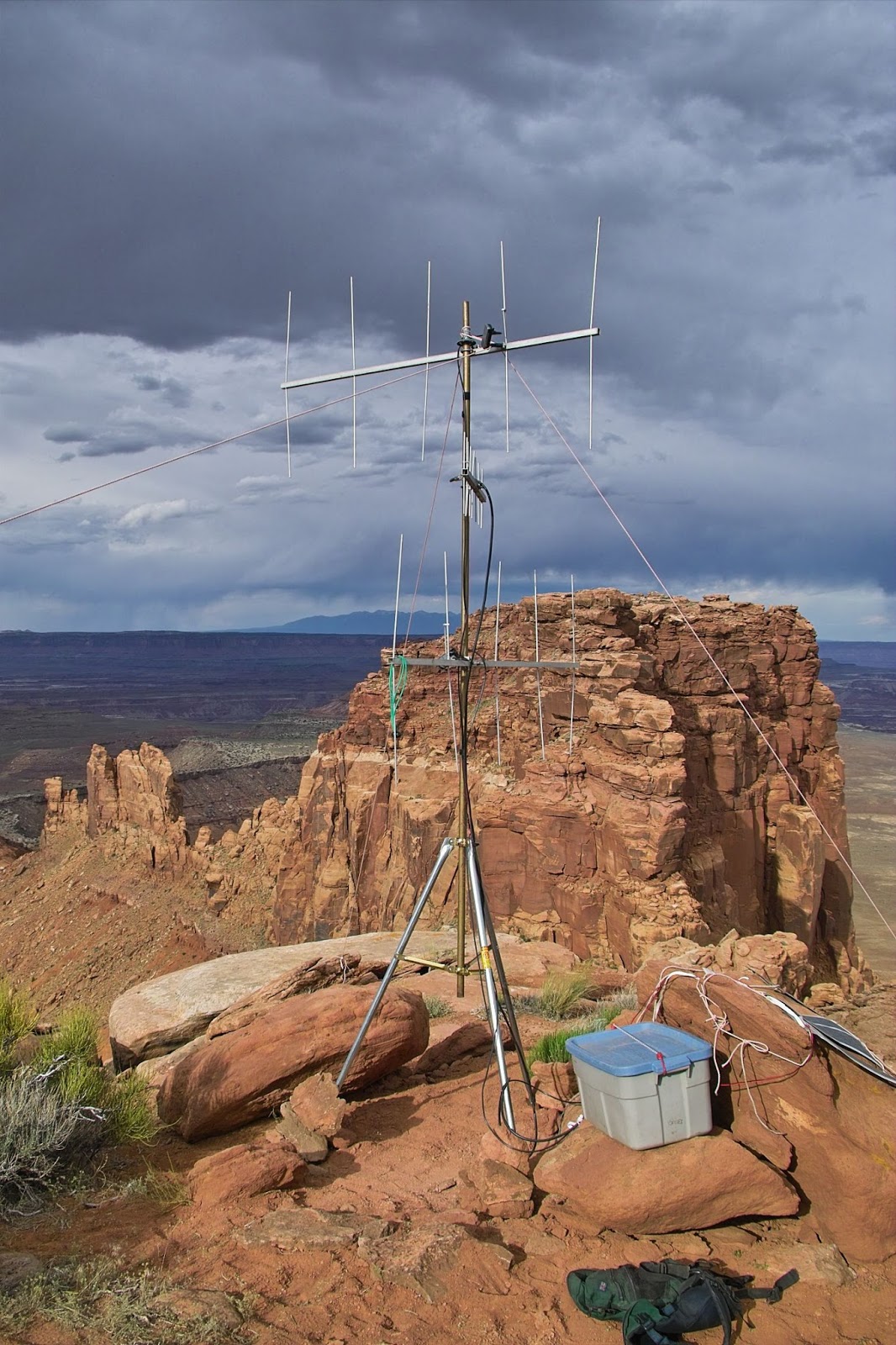
The receive site for the repeater, entirely solar-
powered.  While not obvious from this picture,
this site was on a narrow outcropping of rock
and surrounded on three sides by 1200-
foot (365 meter) cliffs!  Because there was also
rock and distance between it and the transmitter
site, there was excellent TX/RX isolation,
eliminating the need for lossy cavities/filters in
front of the preamplifiers.  In the box, safe from
weather, were the radios, voting/power controller
and 30-ish amp-hours of batteries.
Click on the image for a larger image.

For any receive system with specified attributes (e.g. detection bandwidth and modulation method) there is one fundamental, limiting factor that imposes an absolute limit on how sensitive it can be:  Thermal Noise.   This thermal noise comes from two places:
  • The equipment itself, and
  • The environment in which the receive system is used.
As it turns out, everything gives off noise, assuming that it is warmer than absolute zero, and the warmer it gets, the more "noise" it puts out.

For an example, consider a piece of metal.  At room temperature, it does not "glow" visibly, but if you were to heat it, it would begin to glow - very dull red at first, but as it got hotter, it would become closer to being "white hot."  As it cools again, its glow disappears once more to our vision.  Just because it may have cooled off to room temperature, don't think that it isn't still "glowing" - because it is!  As it turns out, any object that is above absolute zero does glow - not only at infrared wavelengths as you may have seen in footage of police finding criminals in the dark using "heat sensitive" cameras, but also at plain radio wavelengths where it manifests itself as noise.
 

Keeping in mind that all "warm" surfaces "glow" at radio wavelengths, one can complete the analogy by likening a radio signal to a light source on a glowing surface:  If the surrounding surface is "glowing" more brightly than the radio signal, that radio signal is simply lost!
 

The magnitude of this noise with respect to the receive system can be calculated using this equation:
N = k * T * B
Where:
  • N = noise power in watts
  • T = temperature in Kelvin
  • B = bandwidth in Hz
  • k = Boltzmann's constant - which is approximately 1.38x10⁻²³ (expressed in Joules per kelvin, or J/K)
When numbers are crunched, assuming a 300K (about 80 degrees F, 27C) temperature and a 15 kHz receiver bandwidth, we can calculate that in a 50 ohm system, as is used on a typical receiver, this is equivalent to a noise voltage of approximately 0.056 microvolts when using an isotropic antenna completely immersed in a 300K environment.

(Yes, that also means that there is an equivalent signal noise voltage of 0.056 uV - assuming the same detection bandwidth - coming out of a 50 ohm dummy load that is at a temperature of 300K:  It is through the use of the intrinsic noise of dummy loads that EMEers - those that engage in Earth-Moon-Earth communications -  can quickly check the relative performance of their receiver/preamplifier system by comparing the noise level of the "hot" dummy load with that of the "cold" sky.)

The above example assumes that we are receiving a signal using an isotropic antenna, surrounded on all sides by matter that is at 300K.  While this isn't exactly the case in a "real world" scenario, it is a reasonable approximation of actual operation of a receive system in which the signals are emanating from the surface of the Earth.

The numbers calculated above illustrate that our receive system is, in fact, limited by more than the fact that the signal is just getting weak:  The signal is, in fact, being lost in thermal noise being radiated by the earth itself, hence the nature of the title of this article!

But it gets worse!

If you have loss in front of your receive system, this is the equivalent of a noise source.  For example, a 3dB loss in front of a theoretically-perfect preamplifier (e.g. 0 dB noise figure, lots and lots of gain) due to coaxial cable, a bandpass cavity, connectors or anything else will still cause the system consisting of that 3dB loss and our "perfect" preamplifier to have an apparent 3dB noise figure:  Once you lose signal due to attenuation and it goes into the resulting thermal noise, it is gone forever and no amount of gain or any type of amplification after this loss can or will bring it back!

This is exactly why the preamplifier is located at the antenna as depicted in Figure 3:  The only losses ahead of the preamp are those of the matching networks of the antenna and preamp and the kludge of connectors required to mate the antenna to it.  The losses in the coaxial cable after the preamp and the noise figure of the receiver itself still matter, but are comparatively small contributors to the overall receive system noise figure once gain is introduced into the system.

How much sensitivity do we really need?

Fig. 5 - This table shows approximate correlation of receiver sensitivity (12 dB SINAD, 1 kHz modulation, 3 kHz deviation, 15 kHz bandwidth and 6dB/octave receiver de-emphasis) to receive system noise figure
(This information derived from data published by E.F. Johnson Corp. as well as my own empirical testing of radio gear.)

12 dB
SINAD
Sensitivity
Approx.
Noise Figure (dB)

12 dB
SINAD Sensitivity
Approx.
Noise
Figure (dB
)
0.1 μV 3.4
0.3 μV 10.7
0.125 μV 4.6
0.4 μV 13.1
0.15 μV 5.7
0.5 μV 14.9
0.2 μV 7.6
0.75 μV 18.4
0.25 μV 9.2
1.0 μV 20.8
On a typical narrowband FM receiver, 12 dB SINAD turns out to correlate approximately with a noise voltage that is 60% of the signal voltage:  This ratio can vary depending on receiver design, but not by too much.  This means that in a 50 ohm receive system that is terrestrially based (that is, the antenna receives a signal originating from the Earth's surface) or in a test setup involving dummy loads/attenuators that are at room temperature the maximum sensitivity possible - no matter how good your receive system might be (using a standard 15 kHz FM voice channel) is approximately 0.09 microvolts (more or less) for 12 dB SINAD!  

With my receivers having a "barefoot" (no preamplifier) sensitivity of 0.15 microvolts for 12 dB SINAD (approximately 5.7 dB Noise Figure based on Figure 5) I calculated that the worst-case sensitivity, taking into account expected cabling and connector losses and assuming a 0.8 dB noise figure for the preamps, that the overall system noise temperature was likely close to 95k, or about 1.23 dB.  Clearly this was "quieter" than the 300k noise from the Earth itself!  By changing the design of the preamplifiers I could have increased their gain and reduced the system noise figure even more, but doing this might have risked front-end overload of the receivers by also increasing the level of the (strong!) nearby transmit signal, effectively reducing system performance.

Without cryogenic cooling of the entire planet (which would be really bad for most of us!) much better system sensitivity than this was impossible to obtain with the aforementioned receive system

I now knew that my receiver sensitivity was a reasonable match for the sort of "minimum usable" signals that one might experience in an "Earth-bound" receive system:  If I'd made my receive system completely noise-free I would have gained only a dB or so at most since I was already very close to the absolute limit imposed by the noise environment of the Earth - and this did not take into account the antenna system itself.

Exceeding the limits of thermal noise:

The use of directional antennas

The next obvious step in improving the receive system performance still more was through the use of directional, gain antennas.  Because the hub of activity on the rivers was toward the north we had the luxury of being able to use such antennas since there was no need for omnidirectional coverage.  By limiting the the "field of view" of the receive system with these directional antennas (5 element Yagis) and with the apparent signal gain provided, the absolute signal levels (which included the inevitable thermal noise of the Earth) were increased at the input terminals of the preamp, additionally overcoming deficiencies that might be present in the receive system, not to mention helping reject the strong transmit signal 600 kHz away from the receive signal off the backs and sides of the beam as well as rejecting other signals (from where?) that might encroach from other directions.

With this configuration, pretty much all of the signal from the distant transmitter - plus Earth thermal noise - that was being intercepted by the Yagi was being presented to the receiver and there was really nothing more that could be done in practical terms to enhance it further.

Receiver diversity

Even with the preamplifiers and gain antennas, I still wanted to go another step further in improving the apparent sensitivity of the receiver system and this was done by using multiple antennas and receivers in a VOTING arrangement.

Figure 6:
The two matched receivers - modified RCA VHF TacTecs, the UHF link
transmitter - a slightly modified Yaesu FT-470 - and the PIC-based
voting controller/solar charge controller.  These TacTecs have quite
good strong-signal handling due to the use of a moderate amount of
properly-distributed RF gain and a passive diode-ring mixer - somewhat
unusual to find in radios these days!  These TacTecs were modified
to bring out discriminator audio and the squelch "noise voltage" to
interface with the voting controller:  While the absolute squelch level
was fixed in the voting controller, the radio's squelch knobs still adjusted
the "noise voltage" gain and thus allowed, indirectly, the squelch of
each receiver to be adjusted.  The squelch threshold was adjusted
for an approximately 3 dB SINAD quieting audio signal:  While noisy, this
is still quite copiable to the trained ear if the transmitter's modulation
is adjusted properly!
Click on the image for a larger version.
As the name implies, a voting system compares the signal quality from two receivers simultaneously and selects the best one.  Because I was using a pair of identical receivers I had access to the "noise voltage" from the receivers' squelch circuits and made this available externally to the voting controller:  It was a simple matter of comparing the noise voltages of the two receivers to determine which one had the best, "least noisy" signal at any instant and select it.

Because each receiver had its own antenna and preamplifier, and since the two antennas were physically separated from each other in the vertical plane and pointed in slightly different directions, it was more likely that at least one of these receiver/antenna combinations would intercept at least a fragment of the weak, refracted/reflected signal emanating from the distant canyon bottom.

The amount of "gain" that this sort of arrangement provides is difficult to quantify as it varies wildly with circumstance, but with these indirect, "bouncy" and multipath-laden signals emanating from the bottoms of distant gorges it is certainly positive!

Comparing to a "normal" repeater's receive system:

Let us consider the typical overall sensitivity of a typical amateur repeater.  Assuming that there is NO site noise at all (quite unusual for a busy, shared communications or broadcast site!) and an intrinsic receiver sensitivity of 0.15 microvolts - a reasonable (or even optimistic) number for modern gear - and let us add up the various losses that might be found in a typical repeater system:
  • Feedline losses:  2 dB
  • Duplexer/cavity losses: 2 dB
  • Miscellaneous losses:  1 dB
This extra 5 dB would take the original 0.15 microvolts (approximately -123.5 dBm) to around 0.27 microvolts  (-118.5 dBm).  Compare this to the approximate sensitivity calculated for the Panorama Point repeater as being in the area of 0.085 microvolts (-128.5 dBm), we are around 10 dB down which means that the distant transmitter would need a 10-fold increase in power to "sound" the same in our receiver - and this does not consider the somewhat "intangible" gain afforded by the voting receiver system or the degradation due to "Earth noise" contribution.  (It is worth noting that at the signal levels and with the sensitivity of the "typical" repeater's receiver, the noise-temperature contribution of the Earth itself is barely detectable - if at all!)
Would a digital modulation scheme have helped?

With a number of digital modes available for use on VHF such as "D-Star", "DMR" and "System Fusion" it would be reasonable to ask if using a digital mode instead of an analog signal would have improved overall system performance.

The quick answer is NO.

It can be demonstrated that when one approaches a "quieting" of around 12dB SINAD - a slightly noisy but perfectly copiable analog signal - all popular digital modes (those mentioned above) start to fall apart - and using a "voting" receiver system (if one is available!) becomes rather complicated.  If one has a "trained ear" it is even possible to copy an analog signal when its SINAD has degraded to just 3-6 dB - a signal far too weak to even get any digital data through at all - provided that the person at the "other end" is speaking clearly and fully modulating the transmitter.  (For a demonstration of weak-signal FM versus weak-signal D-Star, go here - link.)

What would work significantly better than FM in terms of weak-signal performance by a significant margin (perhaps 10-fold!) and resistance to multipath distortion is good, old-fashioned SSB owing to its narrower bandwidth and more efficient means of conveying voice on the carrier.  In theory it should be possible to construct an "SSB Repeater" compatible with the modern, all-mode and readily-available transceivers, but since this would add apparent complexity on the part of each user, this was not seriously considered!

You may know that with a "typical" repeater consisting of a single antenna and duplexer that it not uncommon to experience a bit of "desense".  This is where some of the energy of the transmitter causes a decrease in sensitivity of the receiver, making the situation even worse!

Consider that both the receiver and transmitter systems for this portable repeater system used Yagi antennas that offered approximately 10dBi gain on both receive and transmit.  When one takes into account the difficult nature of running full duplex on a Yagi with the possibility many "nonlinear" junctions causing a minute amount of energy to be produced and cause some desense - plus the fact that this had to be a "portable" repeater - one can chose to see why we chose to avoid the bulk, expense, loss, and awkwardness of any cavities at all and used a repeater with a geographically separated transmitter and receiver.

All of this leads to an interesting question:  Would an "ordinary" repeater, with its typical single transmit/receive antenna multiplexed with cavities and commensurate losses, plopped down at this location have provided useful coverage in this particular instance?

Based on the observed signal levels:  No, I don't think so!

* * *

The repeater in actual use:

This repeater system was used, with minor modifications, from 1997 through 2011, the most recent Friendship Cruise, and the software for the homebrew, PIC-based voting controller was modified to include charge control of the solar panels, implement power-saving features for the receivers and to report some telemetry with the IDs.  On the transmitter side a 300 watt amplifier was typically used with a 5 element Yagi to blast well over 2kW EiRP in the direction of the boats - all without "desensing" the repeater's receivers in the slightest even though the receive site was generally within the pattern of the transmit antenna!
Figure 7:
The transmit site.  The transmit antenna, a Yagi (a 7 element, in this
particular case) , was located atop a 25 foot (7.6 meter) mast located only
a few 10's of feet away from 1200 foot (360 meter) cliffs on two sides. It
was fed with approximately 300 watts of 2 meter transmit power, directed
toward the location of the activity on the river yielding well
over 2kW EIRP.  Power was provided by a bank of 100 amp-hour
lead-acid batteries that were recharged twice a day at 50-80 amps
with a generator.  In the foreground may be seen the UHF link antenna for
receiving the signal from our own receive site and the link from the "other"
repeater covering the Colorado River as well as a "backup" 2 meter Yagi
used during set-up and in case the main repeater system were to go off
line for some reason.  The transmitter itself was a Kenwood TM-733A
operating in "half-crossband" mode.  Because the ID was provided by the
controller at the receive site - and the main transmitter was relaying this
UHF link - everything was legal!
Click on the image for a larger version.


It is fair to say that the repeater worked phenomenally well!  In the few days that it was online for the event each year that it was used it was not uncommon for someone to stumble upon it while scanning, sometimes from a very long distance, well outside the intended coverage area.  Even though it was intended to cover mainly the Green River's course it turned out that there were very few places on either the Green or Colorado Rivers that the repeater did not cover - or at least where a "hot spot" could not be found.

Because we were "stuck" out in the middle of nowhere at this site, many hours drive from "civilization" for 4-5 days, we had plenty of time to observe how the repeater system worked.  

As you can imagine, in the first couple of years that the voting system was used its behavior was carefully observed to see if it was really helping dig out signals and at times, the local speakers on the two receivers comprising the voting system were turned up while a distant station was transmitting.  It was often the case that one could hear the transmitting station fade out of one receiver - but not the other - as the signal bounced its way out of the deep river gorges and off the rocky rims above, this on two antennas that were about a wavelength apart and pointed in slightly different directions, proving the worth of the voting receivers while offering an eerie "stereo" type effect.

Not surprisingly, standing at the receive site and switching to the repeater's "reverse" (the input frequency) in such situations while listening on a handie-talkie using a large whip typically yielded either a barely detectable signal or nothing at all while the repeater happily relayed signals that were often full quieting!

One of the interesting aspects of this system was the difference in the "sound" of weak FM signals on this system.  On a typical FM repeater system a weak signal develops "popcorn" noise as the signal gets weak - a rather strong, staccato series of random noise pulses that appear on the audio as signals get weak.  While these receivers exhibited this same behavior when connected directly to an antenna, when configured as they were with this system using the GaAsFET, mast-mounted preamplifiers and "Earth noise" dominating this noise and "popcorn" was almost entirely absent with weak signals seeming to disappear into a sea of steady, even "hiss" instead, not too unlike what one hears on VHF/UHF SSB signals.

In the case of Earth-to-Space communications, great care is taken in the design of the antenna system to prevent it from "seeing" the "Earth noise" as much as possible.  If this is done it is possible to construct a receive system that will hear spacebourne signals that are much weaker than those that could possibly be detected from Earth-based sources.  In fact, with such systems it is not uncommon to be able to see a significant increase in "no signal" readings when the antennas are lowered to zero elevation and pick up "Earth noise" as compared to when they are pointed into space - unless they are pointed at the (noisy!) sun - but that's another topic altogether!
Another interesting phenomenon - not too unusual with voting receivers - can occur when two stations are "doubling" (e.g. transmitting at the same time) but just happen to be located such that each one is only getting into only one of the receive system's antennas.  Although it occurred only rarely, it was very odd to hear two completely different voices, both "full quieting" and with no obvious heterodyne, the syllables of speech being randomly interspersed as the voter switched between the two stations!

* * *

Alas, the Friendship Cruise has not been held for several years now as the combination of unprecedentedly low water flow rates in one or both of the rivers and the apparent waning interest has taken its toll.  For those that were involved in the amateur radio portion it was a fascinating exercise in several of the most important aspects of the hobby:
  • Being able to communicate for the public good for the safety and well-being of all of those involved.
  • To give those involved practical, real-world experience in operating out in the field under "less than ideal" conditions where there is absolutely no backup via the commercial or public infrastructure.
  • To try out new ideas and techniques to make communication work in a very challenging geography!
Now, isn't that what amateur radio is all about?

[End]

This page stolen from "ka7oei.blogspot.com".